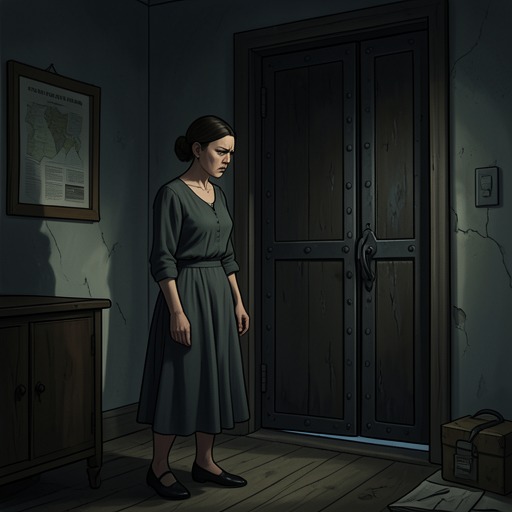
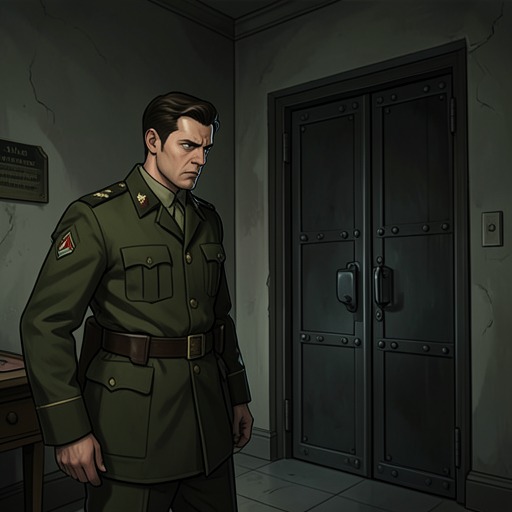
Event 1
Special Train 105's arrival and liquidation
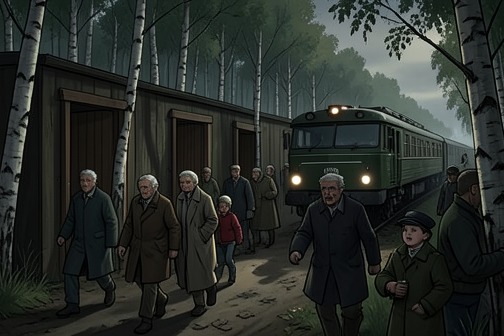
[Special Train 105](entity:object-recall-object-105-8a87358b44d2) arrives at the camp as a transport that appears, at first, unexpectedly small and easy to manage. [Paul Doll](entity:character-recall-character-paul-doll-263bff157203) has prepared a show of force and a carefully staged welcome; the passengers are mostly children and elderly people, and there is no genuine selection because they are already destined to die. The reception leads them from the ramp through the birch wood toward sealed doors, while a truck carrying corpses briefly tears through the illusion of a civilized arrival.
## Warning and Preparation
Doll initially has reason to expect a soft transport: the evacuees are to spend only two days in transit. A second message from Paris changes the mood, warning him that Special Train 105 will test his abilities to the limit. Doll treats the warning as a reason to prepare, arranging a substantial contingent rather than relying on the smaller force usually required for a light transport.
His preparations are specific and excessive. At the ramp he assembles [Wolfram Prufer](entity:character-recall-character-wolfram-prufer-78c6cf90445d), three labour managers, six physicians, disinfectors, [Szmul](entity:character-recall-character-szmul-c827c0d89630) and his twelve-person team, eight Kapos, a hosing crew, and ninety-six troops under [Boris Eltz](entity:character-recall-character-boris-eltz-8a6f6c87ec3a). An additional eight-person unit brings a heavy machine gun, and the force includes two flamethrowers. [Ilse Grese](entity:character-recall-character-ilse-grese-8bcc09a17549) and her platoon are also present. Doll even calls up seven accomplished violinists, preferring them to the usual collection of makeshift instruments. His inventory of personnel and equipment turns the ramp into a carefully controlled stage, though the transport will prove much smaller than the preparations suggest.
As the train approaches, Doll watches it arrive along the long spur. Its carriages appear to be passenger cars, in three classes, rather than the cattle cars associated with transports from elsewhere. When it stops, the first people off are bewildered middle-aged stewards in civilian suits, marked by white armbands. Then come the passengers: a boy of about eight or nine in a sailor suit, an elderly man in an astrakhan coat, and a bent old woman leaning on an ebony cane, followed by the others.
## A Transport Already Condemned
The shipment contains barely one hundred people, not the thousand Doll had expected. Most are under ten or over sixty. The few younger adults are also visibly vulnerable: one man has a club foot, a pregnant woman is among the arrivals, and other passengers use spinal braces or white sticks. Their ages and conditions make the usual calculations of selection beside the point. Boris later states that there was no selection: every passenger was already certain to be sent to the gas.
The old woman separates herself from the hesitant crowd and limps toward Doll with startling speed. She asks whether he is in charge, and he confirms that he is. While the luggage is gathered and the travellers are formed into a column, members of Szmul’s team move among them with courteous greetings in French. Doll addresses the arrivals over a loudhailer, presenting the camp as a place where they can recuperate before going to farm work. He promises accommodation, a warm shower, tea and cheese sandwiches, and a hot stew. Boris translates the gist of the speech into French. The promise of work and hospitality masks the purpose of the procession: the passengers are being directed toward their deaths.
## The Truck and the Rupture of the Welcome
The carefully managed welcome is interrupted by a lorry crossing the rails. Its tarpaulin lifts as it jolts to a halt, exposing its cargo for a few seconds: the day’s corpses from the main camp, on their way to [Spring Meadow](entity:location-recall-location-spring-meadow-598da4499f39). The sight is not unusual to Doll, but the arriving Parisians respond with a howl; [Baldemar Zulz](entity:character-recall-character-baldemar-zulz-42a310612d4b) reflexively raises his arms, and Boris turns toward Doll. The lorry makes the camp’s ordinary dead visible to people whom the speech has just invited to imagine a dignified reception.
Doll responds not by stopping the procession but by directing the musicians to play. At first, the violin melody only reinforces the passengers’ helpless cry. Then it gathers force as the truck pulls free of the crossing and disappears down the road. The travellers continue through the birch wood. Their movement resumes, but the music cannot undo what they have seen; it serves instead as an improvised means of carrying the deception forward.
## Sealed Doors and the Camp’s Daily Reality
The procession passes peeling birch bark and the [Little Brown Bower](entity:location-recall-location-little-brown-bower-1077607d9677), with its picket fence, flowerpots, and geraniums and marigolds. It then reaches the undressing room and chamber. When Prufer signals that the doors have been screwed shut, Doll turns away. The combination of reassuring domestic detail and secured doors makes the route’s destination legible without turning the killing into a spectacle. The later account of the transport confirms that these passengers were all destined for the gas.
The corpses on the lorry belong to a larger system of routine disposal. Boris describes them as a daily accumulation transported from the main camp to Spring Meadow, their bodies starved, wounded, and filthy. At Buna, Doll’s attention repeatedly settles on the business-suited [IG Farben](entity:organization-recall-organization-ig-farben-130dd58aa9f0) designers, engineers, and administrators who pick their way past wounded, unconscious, and dead prisoners with notebooks and measuring tapes. The transport’s orderly handling and the industrial visitors’ work proceed alongside the bodies, joining administrative normality to mass death.
## Deception, Smell, and Retrospective Judgment
The reception’s promise of cleanliness and comfort is undercut by the smell that pervades the camp. Doll acknowledges that arrivals notice it, and elsewhere he complains that the water table has been breached and the smell will become unbearable. The stench is not a separate misfortune from the killing: corpses are moved across the camp landscape, and the environmental consequences of mass death persist beyond the moment of violence. In his later questions, Doll asks why the camp makes the snow brown and why the meadow churns and spits. The transport’s polished passenger cars, staged hospitality, and birch-lined path cannot keep that material reality out of view.
The episode also exposes the gap between competing administrative demands. Doll describes pressure to increase labour for the munitions industries while other authorities press for the disposal of evacuees. Special Train 105 makes that conflict brutally concrete: these passengers are not treated as a labour force to be preserved, and the language of recuperation and farm work is a lie used to direct them through the camp. The scene’s progression—from the warning, to Doll’s numerical preparations, to the false welcome, the exposed corpses, and the sealed chamber—shows how violence is organized through both coercion and performance. Its final image is not a battle or a public execution, but a door closed after a carefully conducted reception.
Event 2
The “Silent Boys” incident
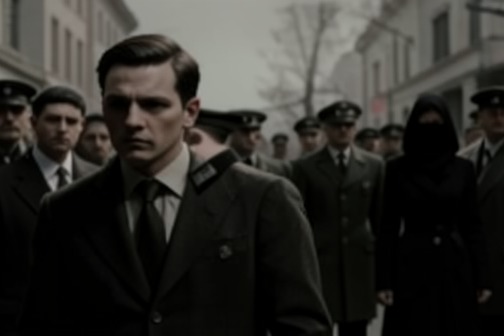
[The “Silent Boys” incident](entity:event-recall-event-2ea42e5f62c8) is [Paul Doll](entity:character-recall-character-paul-doll-263bff157203)’s retrospective name for an Aktion at [Chełmno](entity:location-recall-location-che-mno-fd777d013df9) in January that led to [Szmul](entity:character-recall-character-szmul-c827c0d89630)’s recruitment and induction into the [Sonderkommando](entity:organization-recall-organization-953030afb413). The novel does not narrate the operation in detail; instead, it shows how Doll’s language turns extreme violence into a supposedly exceptional administrative episode, while the knowledge that Szmul’s wife remains in [Litzmannstadt](entity:location-recall-location-83e8c75ca4db) gives the incident a continuing human consequence. Its significance lies both in the making of Szmul into a bearer of camp secrets and in the gap between the perpetrator’s detached account and the prisoner’s knowledge of what cannot be told to those he loves.
## Background and Naming
Doll places the incident in January of the year in which he is writing and locates it at Chełmno. He concedes that the task the [SS](entity:organization-recall-organization-d352e2475f65) set itself there was exceptionally harsh, then qualifies that concession with the language of someone managing an awkward exception: it was perhaps excessive, and people regard it as a rare behavioural curiosity, possibly a one-off. He says that people informally call it the time of the silent boys. The label is memorable, but the account supplies no operational description of the task, no number of victims, and no individual identities among the boys. Its silence is therefore part of the way the incident reaches the reader: its enormity is acknowledged, but its particulars are withheld.
Doll’s phrasing makes the Aktion’s consequence more explicit than its violence. It led to the recruitment and induction of Szmul, whose position among the Sonderkommando makes him a participant in, and witness to, the camp’s killing system. Doll treats that result as a detail in a discussion of an exceptional measure. Yet the shift from a named individual to a procedural outcome cannot make the consequence neutral: Szmul’s forced new role shapes what he knows, what he can communicate, and what he must carry beyond the original event.
## Szmul’s Wife and the Continuing Stakes
The recollection is accompanied by a reminder to find out where Szmul’s wife is. Doll records that she remains in Litzmannstadt, and later describes her as moving through its streets; he adds that [Shulamith](entity:character-recall-character-shulamith-8792b2c168d5) may be needed. The abruptness of the reminder makes the incident extend beyond Chełmno and beyond January. The wife is not an incidental name in Doll’s notes: her whereabouts become a matter he is considering in connection with Szmul’s position and the knowledge he holds.
A separate account gives that connection an intimate weight. Shulamith is still alive in an attic above a bakery, and Szmul has heard news of her three months earlier. He loves her, but believes he is glad never to see her again. He cannot imagine how to tell her about the selections, the disrobing room, Chełmno, or the time of the silent boys. Her safety and their separation thus coexist with the unbearable knowledge created by the camp. The incident’s consequences are not confined to Szmul’s recruitment: they enter the possibility of reunion, making love itself inseparable from what he could not safely or humanely explain.
## Doll’s Plans and the Reach of the Incident
Doll’s notes connect Shulamith’s whereabouts to the Jewish Council in Litzmannstadt. He considers sending a communication to its head, [Chaim Rumkowski](entity:character-recall-character-chaim-rumkowski-7c623390473f), while the earlier reminder asks him to establish where Szmul’s wife is. The text does not state what communication is sent or what comes of Doll’s inquiry. That uncertainty matters: his attention to Shulamith does not resolve her situation, and the reader cannot treat his intentions as proof of protection or rescue.
The contrast between Doll’s records and Szmul’s knowledge is stark. In Doll’s account, a life-changing coercion can be entered as an Aktion and its result summarized as the induction of one man. In Szmul’s account, the same event returns as something he cannot tell his wife. The novel places these modes of narration beside each other without allowing the bureaucratic description to stand as a complete explanation. Doll can classify the incident; Szmul must live with its consequences and with the distance those consequences impose between him and Shulamith.
## Narrative Significance
The incident’s name compresses a history of violence into a phrase that sounds almost like a period label. Doll’s casual reference to what people call it does not soften the event; it exposes the ease with which a perpetrator’s world can convert atrocity into familiar terminology, rare-case discussion, and professional memory. His brief acknowledgment that the task was exceptionally harsh is immediately surrounded by minimization: perhaps excessive, perhaps a one-off. The qualification does not undo his admission, but it reveals the limits of the moral recognition available in his narration.
The novel counters that narrowing through repetition. The name returns in Szmul’s imagined explanation to his wife, beside the selections and the disrobing room, and so ceases to be merely a label for an episode. It marks a boundary in what can be shared between husband and wife. The event is recalled through Doll’s retrospective voice, but its deepest consequence is registered in Szmul’s inability to imagine telling the truth to Shulamith. The account offers no resolution to that separation; the continuing fact of her survival only sharpens the distance between being alive and being able to return to a life together.
Event 3
Wannsee Conference
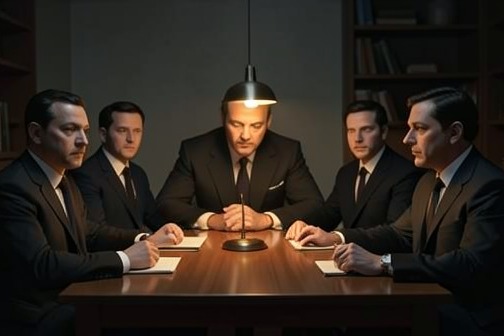
The [Wannsee Conference](entity:event-recall-event-e1e7c62d373f) appears as both an administrative test and a scene of bureaucratic self-congratulation. In the novel, officials praise the intellectual credentials of those involved and describe the meeting in the language of evacuation and efficiency; against that language, [Angelus Thomsen](entity:character-recall-character-angelus-thomsen-4d6c7ca47636) insists that the decision had already been made. Its significance lies in this divide between the polished appearance of deliberation and the machinery of an existing policy of mass murder.
## Setting and Participants
The meeting took place in [Berlin](entity:location-recall-location-berlin-54cb4a75d0f6) at Wannsee and is referred to as the Conference of State Secretaries. Captain Uhl identifies it as a gathering to finalize proposed evacuations to territories in the east. [Paul Doll](entity:character-recall-character-paul-doll-263bff157203) repeats that description with conspicuous confidence, while another participant reduces the destination to a phrase that makes the plan sound like relocation across a border. These formulations expose how administrative language can make a vast crime sound like a matter of transport and jurisdiction.
The discussion gives the conference a broad institutional cast. [Reinhard Heydrich](entity:character-recall-character-reinhard-heydrich-3a78d0693532) convened and chaired it. Doll names Lange, [Gestapo](entity:organization-recall-organization-gestapo-7b5b599b4734) Muller, and Eichmann among those present, calling attention to Eichmann’s clipboard-and-whistle image as if he were a stationmaster managing a timetable. The reference turns a functionary’s practical role into an emblem of how routine administration could serve mass killing. The novel also stresses that many attendees were not the most senior figures in the regime: they were secondary or tertiary functionaries entrusted with carrying policy through government institutions.
## Expertise and the Appearance of Deliberation
Before the conference is discussed, [Baldemar Zulz](entity:character-recall-character-baldemar-zulz-42a310612d4b) argues that intellectual capacity explains Nazi mastery of Europe. He cites memoranda comparing the educational qualifications of officials: fifteen of the twenty-five leaders of the [Einsatzgruppen](entity:organization-recall-organization-einsatzgruppen-d4b9bd17f4e9) operating in [Poland](entity:location-recall-location-poland-919a7f7f62ac) and the Soviet Union held doctorates, as did eight of the fifteen conference attendees. Zulz treats these figures as proof of intellectual depth and as a basis for optimal decisions. Doll echoes him by reducing the point to mental capacity, making the scene’s irony plain: education and administrative competence are presented as evidence of excellence even as they are put in the service of persecution and murder.
Thomsen counters Zulz’s celebratory account with a distinction between discussion and decision. He says that nothing was decided at Wannsee: the attendees merely approved a decision made months earlier at the highest level. In his telling, the conference was an experiment or pilot run, intended to test whether officials would resist applying the regime’s racial policy throughout Europe. The ambition was continental in scale, extending in his account even to Spain, England, Portugal, and Ireland, and involving perhaps ten or twelve million people. He says the test succeeded unexpectedly smoothly: there was no administrative resistance. The meeting thus functions not as the policy’s point of origin but as a demonstration that the institutions assembled to implement it would not obstruct it.
## Authorization and Escalation
A later account in the novel places the policy’s authorization before the conference. Thomsen dates the beginning of the unnamed crime to July 31, 1941, when a letter drafted by Eichmann and Heydrich was sent to Goring and returned with his signature. He describes it as carrying Hitler’s wish for a total solution and granting authority to begin. The sequence matters: the conference’s administrative coordination follows an authorization already issued from above, supporting Thomsen’s rejection of the idea that the meeting itself made the decisive choice.
The same account presents escalation as a process shaped by both central direction and pressure within the occupied territories. Officials may initially have imagined deporting Jews to a cold, barren region beyond the Urals or within the Arctic Circle, a form of extermination through exposure and deprivation. But the territorial prospect receded, while officials in Poland faced the consequences of having annexed an additional three million Jews and claimed they could not manage the numbers. By August or September, Thomsen says, the decisive moral threshold had been crossed: the killing, already directed at men, expanded to women and children. The account therefore joins an upper-level authorization to local administrative pressure and progressively more radical implementation rather than presenting the policy as either a single meeting’s invention or a process without direction.
## What the Meeting Conceals
Thomsen’s account of the meeting’s aftermath sharpens the contrast between its bureaucratic language and its purpose. He describes Heydrich, after the conference, taking a cigar and a glass of brandy in the middle of the day by a fire. Heydrich, Thomsen says, normally drank only alone; beside him, Eichmann curled at his feet. The small domestic scene is disturbing precisely because it follows an account of the meeting as a successful administrative experiment. The ease of the aftermath sits beside the immense human consequences the conference helped organize.
Elsewhere, Professor Peters places the meeting within a larger argument about means and intent. He describes gas chambers and crematoria as methods for speeding the process, economizing, and sparing the killers’ nerves, not as the source of the murderous purpose. In his assessment, bullets and pyres would have been sufficient; he cites the Einsatzgruppen’s killing of well over a million people by shooting as evidence that the perpetrators already had both the will and the capacity to kill on a vast scale. This perspective resists treating industrialized murder as though technology alone created the crime. The conference’s administrative importance belongs to an established intent: it tested cooperation and helped organize implementation, while the forms of killing could change.
## Narrative Significance
The conference is reconstructed through a conversation in which Nazi officials debate their own competence and Thomsen punctures their account of where power resides. Zulz sees educated administrators making optimal decisions; Thomsen sees officials approving a decision already taken and discovers that they offer no resistance. The argument makes the meeting a concentrated image of institutional complicity: responsibility is distributed through offices and chains of command, yet the policy’s direction is not obscured by that distribution. The conference matters not because the novel treats it as the moment when mass murder was first conceived, but because it reveals how readily senior and middle-ranking officials could turn prior authorization into coordinated action.
Event 4
Deaths in Bayer's anesthetic drug experiment
[Deaths in Bayer's anesthetic drug experiment](entity:event-recall-event-bayer-985d113b6930) emerge in a letter that turns the deaths of 150 women into a failed procurement result and a request for replacement subjects. Read by [Angelus Thomsen](entity:character-recall-character-angelus-thomsen-4d6c7ca47636) in [Frithuric Burckl](entity:character-recall-character-frithuric-burckl-bc5fa23937d1)’s office at the [Buna-Werke](entity:location-recall-location-buna-werke-17a8d481e9c2), the report makes the machinery of exploitation visible in its most chillingly ordinary form: a pharmaceutical company, a negotiated price, an unsuccessful experiment, and another order.
## The letter and the experiment
The scene begins with Angelus Thomsen drinking synthetic coffee in Burckl’s office at the Buna-Werke. The letter before him was written by [Bayer](entity:organization-recall-organization-bayer-4ffa6200398f)’s chief personnel officer, addressed to [Paul Doll](entity:character-recall-character-paul-doll-263bff157203), and came from Bayer, a pharmaceutical firm described as a subsidiary of [IG Farben](entity:organization-recall-organization-ig-farben-130dd58aa9f0). Its administrative tone is strikingly composed. It reports that a transport of 150 women arrived in good condition, but that no conclusive results could be obtained because all of them died during the experiments. It then asks Doll to send another group of the same size at the same price.
The letter does not explain the women’s identities, their consent, or what happened to them individually. Its language instead makes their arrival and deaths part of a transaction: the group is counted, its experimental usefulness assessed, and a replacement requested. The absence of conclusive results does not interrupt the process. It becomes the reason to repeat it.
The experiment concerned a new anesthetic. Burckl explains that Bayer had overdone the dose, treating the immediate cause of death as an obvious technical mistake. Yet the report gives no dose, medical findings, or account of how the deaths occurred. What it does record is their totality: all 150 women died, and the company still framed the result as a problem to be solved by sending more subjects.
## Price, repetition, and responsibility
Thomsen responds by asking how much a woman costs. Burckl answers that the price was 170 Reichsmarks each: Doll had wanted 200, but Bayer negotiated the figure down. The exchange places bargaining over human beings alongside the experiment’s medical purpose. The amount is not incidental detail; it reveals that the women had been assigned a sale price and that the buyer and seller could dispute it even as the experiment ended in mass death.
Burckl calls Bayer’s conduct indicative of a faulty attitude. His objection is not presented as a defense of the women’s rights or a demand that the experiments stop. Instead, he asks whether they all died at once or received the same dose, or whether deaths came in batches or one by one. Those questions expose the lack of learning behind the experiment: if the deaths varied over time, the company had opportunities to recognize and correct its errors, yet, in Burckl’s account, it repeated them. His criticism thus identifies recklessness while remaining framed in terms of procedure and avoidable failure.
The request for another 150 women makes that failure cyclical. The first group’s deaths did not end the experiment or prompt the company to reconsider using prisoners. Bayer’s response, as reported in the letter, was to ask for a replacement group at the same price. Responsibility is distributed among the company that conducts the tests, the camp authority that supplies the women, and Doll, who sets a price. The scene offers no single dramatic order of execution; it shows lethal violence passing through an ordinary chain of correspondence and negotiation.
## The camp’s administrative logic
The exchange belongs to a wider world in which people are sorted, counted, assigned, and processed. In another camp operation, Doll prepares a large force of guards and staff for a train’s arrival, while invoking a rule of thumb that roughly 1,000 people travel on each train and as many as 90 percent may be selected for one side. Elsewhere, he insists that skulls be carefully counted. These are not details of Bayer’s experiment, but they echo the same institutional habit: human beings become quantities to be allocated or enumerated.
The handling of bodies after killing extends that logic beyond death. The [Sonderkommando prisoners](entity:concept-recall-concept-d41d95e727bf), under [Szmul](entity:character-recall-character-szmul-c827c0d89630)’s authority, remove gold teeth and hair, take rings and earrings, hoist bodies to the furnaces, grind the ashes, and send the resulting dust away by truck. Their coerced work is described as a process carried out with numb indifference. This separate account does not establish what happened to the women who died in Bayer’s experiments; it does show the larger camp system’s capacity to turn human remains into successive tasks and outputs.
Doll’s own justifications deepen the contrast between administrative order and moral reality. He presents himself as a normal man and argues that kindness to Jews would be cruelty to Germans, replacing ordinary moral distinctions with a calculation of positive and negative outcomes. In another conversation, he declares agreement with the Reichsführer-[SS](entity:organization-recall-organization-d352e2475f65) against pampering prisoners. Against that background, Bayer’s letter appears not as an isolated technical mishap but as an instance of a political and institutional environment where the deaths of prisoners can be discussed as a defective procedure or a failed use of resources.
## Narrative significance
The episode gains force from the gap between the letter’s calm business language and what it reports. The women arrived in good condition; the experiments yielded no conclusive results; all the women died; another group was requested. The repeated administrative phrases do not soften the violence. They show how a lethal act can be made to resemble routine procurement, with the human cost reduced to a number and a price.
Burckl’s criticism complicates that exposure. He recognizes that Bayer is repeating mistakes and that treating a workforce as disposable can be counterproductive; elsewhere he recounts a worksite clash in which a prisoner, a prisoner-of-war, and a Kapo were injured or killed, delaying the movement of cables. His perspective challenges waste and operational inefficiency, but the letter scene does not show him demanding an end to the experiments. The distinction matters: criticism of the way violence is managed is not the same as rejecting the violence itself.
By letting Thomsen encounter the report and ask the price of a woman, the narrative makes the commercial calculation audible without supplying a consoling resolution. The experiment’s result is not scientific knowledge but a request to repeat the test with another group. That ending exposes the governing contradiction: an institution may describe its work in terms of expertise, procedure, and productivity while making the lives of its captive subjects expendable.
Event 5
Esther Kubis's postcard, imprisonment, and release
[Esther Kubis](entity:character-recall-character-esther-kubis-635617c9f2ac)’s imprisonment and release turn a small act of political resistance into a test of how power operates inside the camp. Accused of sabotage and placed in [Gestapo](entity:organization-recall-organization-gestapo-7b5b599b4734) custody, she faces confinement that could leave her without food or water. [Boris Eltz](entity:character-recall-character-boris-eltz-8a6f6c87ec3a)’s response shifts from punitive hesitation to urgent intervention: he eventually secures her release through a costly appeal to officials and a direct threat. The episode’s stakes lie both in Esther’s survival and in the compromises required to retrieve her from a system that has made her vulnerable.
## The postcard and the charge of sabotage
Esther’s imprisonment follows a political act that the authorities treat not as private discontent but as a crime. Boris Eltz calls it sabotage, emphasizing that Esther’s conduct has crossed into direct opposition to the camp’s order. The passage does not reproduce the postcard’s full contents; instead, it gives the reader Boris’s account of Esther’s own explanation. On arriving at the camp, she told herself, “I don’t like it here, and I’m not going to die here.” Her words make her resistance plain without turning it into a formal manifesto: she rejects the expectation that she should accept the place and submit to the future assigned to her.
That declaration also changes how Boris Eltz interprets her behavior. He presents Esther’s actions as consistent with a decision to resist rather than endure quietly. Yet the narrative does not spell out the precise mechanics of the sabotage in this exchange. The charge is significant in itself: an act the authorities classify as political crime places Esther in the hands of the Gestapo and exposes her to confinement. The story therefore links a determined assertion of agency to the immediate danger of being processed by an institution capable of imposing punishment without the protections available outside the camp.
## Confinement and Boris Eltz’s hesitation
When [Angelus Thomsen](entity:character-recall-character-angelus-thomsen-4d6c7ca47636) asks where Esther is, Boris Eltz says that she has been put in [Bunker 11](entity:object-recall-object-bunker-11-0ce8dd45efb3). His first thought, he explains, had been to take her food and water that night. He then revises that intention: perhaps a couple of days inside would do her good and teach her a lesson. The change is revealing. Boris Eltz recognizes the immediate material risk of leaving Esther without supplies, yet briefly treats that deprivation as discipline that might correct her behavior. His concern for her and his wish to control her are present at the same time.
The episode does not present Boris Eltz as a detached observer of an impersonal procedure. Esther’s confinement becomes a personal decision for him: whether to help her immediately or allow her to remain there. His remark about letting her learn registers the coercive logic of the camp even as he speaks from a position that gives him some ability to intervene. Esther, by contrast, is in Gestapo custody and cannot simply arrange her own release. The imbalance between them is not abstract; it determines who can consider waiting and who bears the physical consequences of that delay.
## The delayed effort to secure her release
Boris Eltz’s initial hesitation does not settle the matter. The attempt to get Esther out is delayed for nearly two weeks, during which the circumstances around her make intervention more urgent. Boris Eltz is sent to Goleschau, a subcamp, with orders to purge and reinvigorate its demoralized guardhouse. Before leaving, however, he has to get Esther out of Block 11; in the narrator’s account, this takes priority because Esther would have starved in his absence. Her release is therefore not a completed rescue that can be postponed at will. The possibility of starvation places a concrete limit on the delay.
Boris Eltz must navigate an improvised chain of authority and payment. Esther is in Gestapo custody, while [Fritz Mobius](entity:character-recall-character-fritz-mobius-e3c937040e4e), described as non-venal, is away on leave. Mobius’s deputy, Jurgen Horder, is in the Dysentery Ward of the Ka Be. Boris Eltz therefore applies to [Michael Off](entity:character-recall-character-michael-off-fea51533b82a), whom he hopes will cost less than Horder. The sequence conveys how precarious the route to release is: the people who might be approached are absent, ill, or expected to demand money, and Boris Eltz must find another point of access before departing for Goleschau.
## Payment, threat, and release
Boris Eltz later recounts what he tried. He says that money had become a poor instrument in the camp because so much was circulating, a condition he compares to inflation and connects to the abundance of jewelry. In dealing with Michael Off, he bid one thousand Reichsmarks. He had already given five hundred to an old man at the Postzensurstelle; when the woman involved demanded ten, he abandoned bargaining and threatened to break her face unless she released Esther immediately. The account does not describe an orderly appeal or a formal review of the sabotage charge. It shows a release pursued through money, access, and threatened violence.
His account ends not with a detailed description of Esther’s return but with the practical fact that the car was waiting. Boris Eltz says he could think of nothing else to do. The briskness of that ending leaves the means of release starkly visible: Esther’s freedom depends on a sequence of payments and a threat made by someone with the power to make it credible. His earlier plan to let her suffer for a couple of days gives way to action because the delay has become dangerous and he is about to leave.
## The episode’s significance
The event holds together Esther Kubis’s refusal to accept the camp as her fate and the compromised means by which Boris Eltz gets her out of confinement. Her words establish an intention to resist; the accusation of sabotage converts that intention into a reason for detention. Boris Eltz’s response is neither simple rescue nor consistent cruelty. He first contemplates withholding help as a lesson, then treats her impending starvation as a reason to prioritize her release, even at a cost to himself and through a threat of violence.
The sequence also makes the camp’s coercion legible through its bottlenecks: Bunker 11, Gestapo custody, an absent official, a deputy in the Dysentery Ward, money changing hands, and a car waiting to depart. Release is not represented as the restoration of an ordinary right but as an outcome extracted from a system whose agents can detain Esther and obstruct her return. The postcard and its surrounding episode thus mark both the danger of Esther’s resistance and the limits of the protection Boris Eltz can offer: he can get her out, but only by operating through the same network of power, payment, and intimidation that made her confinement possible.
Event 6
Spring Meadow corpse-incineration project
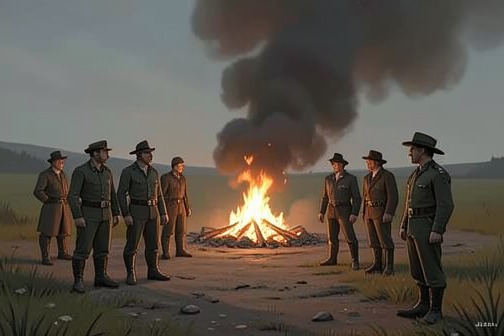
The [Spring Meadow corpse-incineration project](entity:event-recall-event-4ed4221c3c5b) turns the disposal of the dead into an administrative and technical operation: [Paul Doll](entity:character-recall-character-paul-doll-263bff157203) orders the remains burned and ground to conceal evidence, while the pyre’s smoke, heat, and pollution make that concealment visibly fail. Its account moves between orders, improvised engineering, and the corrupted landscape, showing how mass murder is managed as work—and how its material consequences escape the boundaries of the site.
## Mandate and institutional pressures
The immediate order comes from [Horst Blobel](entity:character-recall-character-horst-blobel-e575716d3b31). Doll tells [Wolfram Prufer](entity:character-recall-character-wolfram-prufer-78c6cf90445d) that it comes from Blobel and therefore from the Reichsführer-[SS](entity:organization-recall-organization-d352e2475f65), presenting compliance as a matter of hierarchy. Prufer objects that the task is impossible. Doll rejects the word as incompatible with the SS’s supposed ability to overcome objective conditions, but Prufer’s practical question—what purpose the work serves—exposes the uncertainty beneath the command.
Doll’s answer is political: the operation is intended to cover their tracks, and the ashes must also be ground in bone mills. The aim is not simply to dispose of bodies, but to remove traces that might later be examined. Prufer counters that concealment will matter only if [Germany](entity:location-recall-location-germany-2e3723c2f347) loses, a possibility the regime refuses to acknowledge. Doll admits that the same thought has occurred to him, yet insists that even victory cannot guarantee freedom from future questions. The project is thus organized around a contradiction: officials insist that the Reich will prevail while acting as though its crimes may eventually be investigated.
Doll describes Blobel as responsible for clearing an entire territory and says he repeatedly asks for [Sonderkommando prisoners](entity:concept-recall-concept-d41d95e727bf), using them up after each Aktion. Doll complains that Blobel will not make these forced laborers last longer. This exchange makes the human cost part of the administrative language: the prisoners are discussed as a depleted resource, while their assigned task is to erase evidence of the killings that have made them useful to the perpetrators.
The operation also sits within a wider conflict over deportees and labor. Doll sees the [Economic Administration Head Office](entity:organization-recall-organization-86ca0fe228fe) pressing him to increase the workforce for the munitions industries, while the Reich Central Security Department presses for the disposal of as many evacuees as possible. His account does not present the corpse-burning project as a resolution of those competing demands. Instead, it reveals a regime in which exploitation and extermination proceed together, coordinated through departments whose pressures meet in the camp.
## [Spring Meadow](entity:location-recall-location-spring-meadow-598da4499f39) and the scale of the remains
Doll had not visited Sector 4IIIb(i) since July, when he accompanied [Heinrich Himmler](entity:character-recall-character-heinrich-himmler-a4a603349601) on a day-long inspection. Returning by truck, he and [Szmul](entity:character-recall-character-szmul-c827c0d89630) approach a mound with Prufer and other officials standing nearby. The meadow begins roughly ten metres beyond it, but the site announces itself before Doll reaches the field: he can hear the remains popping, splatting, and hissing, as well as smell them. The sounds make the work impossible to treat as a distant administrative abstraction.
Doll insists on his own normality and disavows sentimentality, explaining his conduct to himself through loyalty to Germany and the regime’s claims about national good and harm. That self-justification sits beside the physical evidence in front of him. The field is not a symbolic landscape imposed by an observer; it is a place where the disposal process is audibly and visibly under way. When Prufer reports that Blobel tried to blow up the bodies at Culenhof, Doll asks what that would have achieved. Prufer says it did not work and that the upper portions were simply left there. The failed attempt underscores that destroying remains is not a single, clean action: each method leaves material behind.
Doll later describes the surface as undulating like a lagoon at a turning tide, with geyser-like eruptions and pieces of turf leaping into the air. He calls for Szmul, who has descended from the truck into the scene. The comparison to a landscape in motion is inseparable from the process beneath it: the ground itself seems to answer the work of burning and disposal. The meadow is both the site of the operation and evidence of its failure to make death disappear.
## The pyre and its operation
Doll records the practical problem in blunt terms: naked bodies do not catch fire easily. Initial attempts using wooden planks produce only modest accumulations and little progress. Szmul, the [Sonderkommando](entity:organization-recall-organization-953030afb413) leader, then supplies a series of suggestions that Doll says prove decisive. The first is to maintain a single pyre rather than several separate fires; the second is to keep it burning continuously, twenty-four hours a day. These principles convert a faltering effort into a permanent process.
The third measure is to use liquefied human fat to assist combustion. Szmul organizes run-off gutters and teams to ladle the fat back onto the fire. Doll notes that the procedure saves considerable gasoline and reminds himself to make sure Blobel and Benzler are told about the saving. That detail reveals the project’s chilling fusion of murder and economy: a technique devised to sustain the burning is also evaluated as a reduction in fuel costs. The officials’ attention to efficiency does not soften the violence; it shows how thoroughly the violence has been absorbed into routine calculation.
The fire’s intensity creates its own technical obstacle: at times it is too hot for workers to approach. Under Szmul’s direction, the Sonderkommando prisoners construct a vast lattice from warped railway tracks, a structure Doll compares in size to a cathedral in Oldenberg. Workers load it using wide ladders and hoists, then retreat to wheeled towers from which they feed the fire, sometimes throwing in pieces by the bucketful. Doll likens the towers to siege engines. The comparison makes the operation resemble a machine of war, while the monumental scale of the structure gives the process an industrial, engineered form.
At night, the tracks glow red, and Doll says that even with his eyes closed he continues to see the image of a huge black toad with illuminated veins. The vision registers the pyre’s persistence beyond the immediate act of watching: the fire’s pattern remains with him after he looks away. Meanwhile, the nocturnal conflagrations provoke an angry complaint from Lothar Fey of the Air Defence Authority. The flames cannot be fully contained within the operation’s intended secrecy; their light and smoke become a problem for other institutions.
## Contamination, exposure, and significance
The effects reach beyond the pyre. Doll makes Prufer taste the local water, explaining that he had to drink it himself after being invited to the civic centre in [Old Town](entity:location-recall-location-5916ed9a7cff) to face a delegation of local officials. They say that the water remains undrinkable however many times it is boiled. The remains have begun to ferment, and the water table has been breached. Doll warns that the smell will become unbelievable; Prufer replies that it is already so. The exchange makes contamination an immediate public consequence, not merely a prediction about the site.
Doll’s later drive back from the area extends that exposure into the journey. While the guards sleep and he drives, he repeatedly pulls over to lean out of the window and smell the air. It is as bad as he has known it, and keeps getting worse. His description of feeling trapped in a dream of an unstoppable eruption of filth gives the pollution a bodily, engulfing form. The attempt to remove the evidence has instead produced a smell that follows the officials beyond the field and a contamination that enters the water supply.
The project’s material consequences sharpen the account’s broader historical argument. In a later conversation, [Professor Entress](entity:character-recall-character-professor-entress-fdce3fbcfcd0) explains that the gas chambers and crematories were means of accelerating killing, economizing, and sparing the killers’ nerves; bullets and pyres, he says, would have accomplished the same end because the perpetrators had the will. That reflection places Spring Meadow’s improvised pyre within a larger system of extermination without making the project’s specific methods incidental: here, the remains must be burned, the ashes ground, the fuel economized, and the work kept running around the clock.
Doll’s narration repeatedly exposes the distance between administrative intention and physical result. The project is meant to suppress traces, yet the field erupts, the fires illuminate the night, the water becomes undrinkable, and the odor worsens along the road. Its procedures depend on Szmul’s coerced expertise, but the officials discuss that expertise as a means to improve throughput and save gasoline. Spring Meadow therefore becomes not only a site of corpse disposal but a record of how the perpetrators’ systems operate: through orders, delegated labor, technical adjustment, and cost calculation, with consequences that their own machinery cannot keep buried.
Event 7
Doll's injury and Bohdan's death
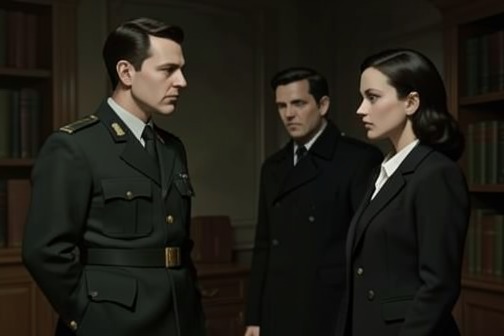
[Paul Doll](entity:character-recall-character-paul-doll-263bff157203)'s injury and [Bohdan Szozeck](entity:character-recall-character-bohdan-szozeck-9bb807efe945)'s death expose how a fabricated account of violence becomes lethal inside the camp. Doll attributed his black eyes to Bohdan, helping to set in motion the order that killed him; [Hannah Doll](entity:character-recall-character-hannah-doll-2c2e53cda395) later disclosed that she had struck her husband, while [Dov Cohn](entity:character-recall-character-dov-cohn-d271ea5f3448)'s account revealed that Bohdan had actually helped Doll after seeing him fall. The event is therefore both a murder and a story about the power of a lie: Bohdan's kindness becomes entangled with the weakness he witnessed, and Doll converts that exposure into grounds for punishment.
## The injury and the cover story
The chain of events begins with an altercation between Paul Doll and Hannah Doll. [Angelus Thomsen](entity:character-recall-character-angelus-thomsen-4d6c7ca47636) later reconstructs the likely sequence: Hannah struck Doll in the face, and as the bruises darkened over the course of the day Doll needed an explanation for his disfigurement. At some point Bohdan attracted his attention, perhaps through clumsiness. Doll then invented a story involving a shovel and passed it, together with instructions, to [Wolfram Prufer](entity:character-recall-character-wolfram-prufer-78c6cf90445d); Prufer's adjutant notified the Punishment Commando. Thomsen presents this as the likeliest sequence rather than as something he witnessed, and initially identifies Torquil's fate as the remaining mystery.
The false attribution surfaces in Thomsen's conversation with Hannah. He tells her, smiling, that Bohdan is dead and relays the version he has received from [Boris Eltz](entity:character-recall-character-boris-eltz-8a6f6c87ec3a): a mishap with a garden tool, followed by Doll's order to Wolfram Prufer and the dispatch of the Punishment Commando. Thomsen withholds the gas from his account, but recognizes that Hannah understands what happened. When he repeats the claim that Bohdan gave Doll his black eyes, Hannah corrects him: she, not Bohdan, struck Doll. Her mirthless smile widens and tightens as she speaks. The revelation does more than identify the original blow; it exposes how Doll's injury was made into a pretext for directing punishment at someone else.
## Bohdan's last morning
Dov Cohn's testimony supplies the scene behind the competing stories. On Bohdan's last morning, Bohdan went to the Ka Be to have the dressing changed on his infected knee, then arrived at the Doll villa garden later than usual, at about half past nine. He was in the conservatory when Paul Doll reeled out through the glass doors of the breakfast room, one hand pressed to his face and still wearing his pyjamas. Bohdan initially took Doll for a prisoner: a new arrival, or Zugang, with a still-fat stomach and clean clothes, who seemed drunk, mad, or disoriented.
Doll saw the tortoise moving across the lawn, picked up a shovel, and brought its flat blade down hard on the animal's shell. He then fell backward onto the gravel. His pyjama bottoms had come undone and tripped him. The detail of the fall complicates any picture of Bohdan as the aggressor: in the account Dov gives, Doll is the one who strikes, and his victim is the tortoise. Bohdan did not exploit Doll's helplessness. He went out, helped him up, settled him on a stool in the shade, and fetched him a bottle of water. Doll waved him away.
Bohdan had already walked from the Stammlager to say goodbye to Dov and warn him not to look for him at the villa. He then went back, waiting for the punishment he expected. Dov knew why: Bohdan had been there when Doll showed weakness and had seen the Kommandant cry. That private observation, not an assault on Doll, is the knowledge that Bohdan believed had sealed his fate. The contrast is stark: Bohdan's response to Doll's vulnerability was practical care, while Doll's response to being seen vulnerable was to turn an invented accusation into an order backed by camp authority.
## The killing and its aftermath
Thomsen and Hannah preserve their smiles while he recounts what Boris told him, but the performance of ordinary conversation cannot disguise the killing. Hannah asks whether Bohdan went to [Stutthof](entity:location-recall-location-1d84398f25ed); Thomsen answers that he went nowhere. She also asks about the tortoise. Thomsen calls its destruction Bohdan's parting gesture, while acknowledging that this is effectively her husband's version, filtered through several intermediaries. Her question and his qualification keep the account unsettled: the story Doll circulated is not the same as the sequence reconstructed from Dov's testimony.
The account of Bohdan's death includes the order to Wolfram Prufer and the dispatch of the Punishment Commando. Thomsen says nothing to Hannah about the gas, though he knows that she understands. The omission is significant because the polite, smiling exchange is itself a form of concealment: the violence is present, but it cannot be spoken plainly in that conversation. Elsewhere, Bohdan's expectation of death is echoed by Boris's memory of him sitting by a door, marking time and giving away his possessions. The scattered accounts converge on a man who knew the danger was coming and behaved as though there would be no return.
## The camp as a system of consequence
Thomsen's reconstruction places the personal deception within a deliberately replicated camp landscape. On the same Friday, he walks through [Kat Zet III](entity:location-recall-location-kat-zet-iii-428dcd604aa1), built and financed by [IG Farben](entity:organization-recall-organization-ig-farben-130dd58aa9f0) on the model of [Kat Zet I](entity:location-recall-location-kat-zet-i-9d1fd36655ba) and [Kat Zet II](entity:location-recall-location-kat-zet-ii-6fa59e519bdb). Its searchlights, watchtowers, barbed wire, high-tension fencing, sirens, gallows, guards, punishment cells, whipping post, mortuary, and other facilities reproduce the apparatus of confinement. In such a setting, Doll's fabricated story does not remain a private lie. It moves through a chain of command and becomes an instrument of organized violence.
Doll's own justifications elsewhere make that machinery harder to mistake for mere procedure. He insists that he is a normal man with normal feelings, then says that kindness to a Jew would be cruelty to [Germany](entity:location-recall-location-germany-2e3723c2f347) and replaces ordinary distinctions between right and wrong with calculations of positive and negative outcomes. His angry declaration that there will be no pampering belongs to the same moral logic: cruelty is presented as discipline, while the victim's suffering disappears behind the language of duty and political purpose. His account of Bohdan's supposed attack performs that logic on an intimate scale, transforming Doll's own injury into an excuse to punish another person.
The event also resonates with Doll's later questions about the camp's stench, the churned meadow, brown snow, and the drunkenness of those who carry out its work. On the Reich Day of Mourning he wonders why, if their actions are good, they smell so bad, and observes that the language of obedience contains the corpse. That later reckoning does not undo what happened to Bohdan. It does, however, sharpen the event's central contradiction: a regime that claims to serve Germany produces death through routine orders, while its functionaries keep speaking as if positive outcomes could erase the human cost.
Event 8
Hannah Doll and Golo Thomsen meet in the shelter pavilion
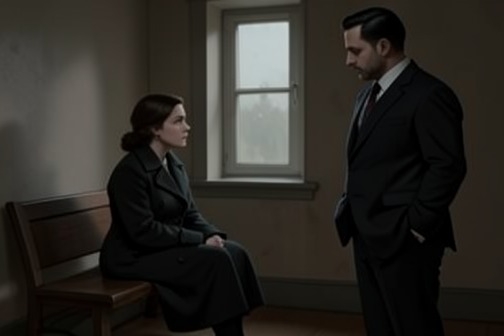
The meeting between [Hannah Doll](entity:character-recall-character-hannah-doll-2c2e53cda395) and [Angelus Thomsen](entity:character-recall-character-angelus-thomsen-4d6c7ca47636) takes place in an unfinished shelter beside the hedge marking the Zonal boundary. Its decisive turn is intimate but not conclusive: after watching Hannah sleep, Thomsen embraces her, yet they do not kiss; when she begins to speak of [Dieter Kruger](entity:character-recall-character-dieter-kruger-1afea31a0f8f), he recognizes that he is involved in something whose course cannot simply be abandoned. The scene makes a beginning out of stillness, grief, and an unfinished structure, without resolving what Hannah’s disclosure will mean.
## The Unfinished Shelter
Thomsen comes upon the pavilion almost by chance. Someone has begun building it just before the Zonal boundary and then run short of time and timber. The result is neither a finished public building nor a secure enclosure: a planked back, two side walls of unequal length, and only half a roof. Its resemblance to a rural bus-stop shelter makes it a place for waiting, but here the waiting is private and precarious. The hedge marks a boundary nearby; the open windows and incomplete roof provide no firm separation from the world around them.
Inside, the details are spare: there are no panes in the windows, only a flat wooden bench. Hannah is in the corner with a blue oilskin spread over her lap, asleep so deeply that Thomsen describes her as dead to the world. The oilskin is a specific, practical object in an otherwise bare setting; the scene does not explain why she has it or what has brought her there. Instead, the pavilion’s exposed, unfinished character gives the encounter its form. It offers shelter without suggesting safety, and a pause without making clear what can follow it.
## Watching Hannah Sleep
The hour Thomsen spends beside Hannah is remarkably still, but the stillness is made up of minute changes. Her frowns come and go, each registering a different trace of puzzlement or pain. Her nostrils flare three or four times with what he reads as subliminal yawns; a tear gathers, drops, and melts into her cheek; once, a childish hiccup shakes her. These movements do not amount to a conversation or an explanation. They make her sleeping body the scene’s evidence of life before she can speak for herself.
Thomsen attends closely to the rhythm of her breath, calling it an iterated proof of her existence. His language makes the observation more than passive waiting: in a landscape and historical setting marked by death, each breath insists on the presence of a living person. But this attention does not give him access to Hannah’s thoughts. Her changing expressions remain unreadable, and the hour’s intimacy depends on that limit. He can watch her breathe and see a tear fall; he cannot yet know what she will say when she wakes.
## Recognition, Words, and Restraint
When Hannah opens her eyes, she looks at Thomsen with so little loss of composure that he feels already established in her dream. The impression is his, not a confirmed account of what she has dreamed. Her first words, in German, ask what they are doing there with the unimaginable ghouls. Thomsen presents the question as steady and sincere rather than rhetorical. It breaks the hour’s bodily quiet with a direct confrontation with the dead around them, while leaving the referent of her question broad: the scene does not specify a particular corpse or identify the ghouls more narrowly.
Hannah stands and they embrace. They do not kiss—not even when she begins to cry and, as Thomsen understands the moment, they may both desire a kiss. He makes the withheld kiss explicit, then recognizes that he is already involved. The restraint matters because the embrace is not treated as a complete declaration or a settled relationship. Physical closeness has begun; a boundary remains. The scene holds attraction and hesitation together without assigning the hesitation a motive beyond what Thomsen can observe.
## Dieter Kruger and the Unfinished Beginning
Eventually Hannah begins with the name Dieter Kruger. The account stops at the opening of her disclosure: it does not recount what she says about him or explain his place in her past. That interruption leaves the name carrying weight without turning it into a resolved revelation. Thomsen’s response is not to claim knowledge of what comes next. He understands that whatever has begun between them will have to go forward, even though its meaning and course are not yet clear.
The ending returns to questions of direction: where now, and where to? They are not answered before the narrative moves on. The unfinished pavilion, Hannah’s incomplete opening, and Thomsen’s unresolved questions converge in an ending that marks a threshold rather than a destination. The encounter establishes a new emotional commitment while keeping its terms uncertain. It begins with the sight of Hannah asleep, passes through her waking recognition and their embrace, and leaves both characters facing what has not yet been said.
Event 9
Execution of Polish Home Army prisoners at Bunker 3
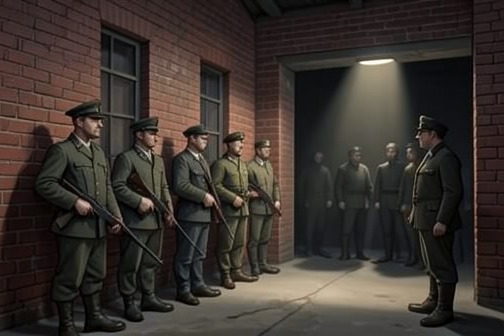
The [Execution of Polish Home Army prisoners at Bunker 3](entity:event-recall-event-bunker-3-99b99d3f2af1) is presented as an organized massacre whose administrative calm cannot conceal its purpose. At a briefing in the camp’s windowless basement, the prisoners are told that every one of them will be shot that afternoon. The account then follows the threat into its execution: a small group fights back, while 291 men are shot between 17:10 and 17:45. Their final soup, postcards, patriotic songs, and cries of “Long live [Poland](entity:location-recall-location-poland-919a7f7f62ac)” stand against the machinery of intimidation that has already made the killings a matter of schedule.
## Background and Assembly
The immediate setting is [Bunker 3](entity:location-recall-location-bunker-3-ad00d26df35e), a red-brick, windowless building. The day’s proceedings begin at 06:28, after [Paul Doll](entity:character-recall-character-paul-doll-263bff157203) has spent a troubled night drinking heavily and has taken a sedative in the early morning. He arrives feeling unwell and sees the meeting through a first-person account marked by physical disorientation. Present with him are [Wolfram Prufer](entity:character-recall-character-wolfram-prufer-78c6cf90445d), [Fritz Mobius](entity:character-recall-character-fritz-mobius-e3c937040e4e), two agents from the Political Section, and Captains Drogo Uhl and [Boris Eltz](entity:character-recall-character-boris-eltz-8a6f6c87ec3a). A translator is dismissed on the claim that the Polish prisoners, described as “old numbers,” understand German well enough.
The prisoners enter in columns of five, led by a single armed guard. Their appearance unsettles Doll’s expectations: they are about 300 men, muscular and well-fed enough to fill out their striped uniforms, some wearing real shoes. The narrator compares their bearing to that of a crack military unit and briefly imagines leading them in battle. Their strength matters not just as a striking contrast to the camp’s usual image of prisoners as emaciated, but because the assembled men are identified as members of the Polish Home Army. They are not an anonymous labor group; they belong to a resistance movement whose capacity to act is precisely what the officers seek to contain.
## The Threat and Its Terms
Mobius announces that each prisoner will be shot, probably at about five that afternoon. The statement is delivered openly, without the false promise of release. He explains that the men have held back because they cannot persuade their center in [Warsaw](entity:location-recall-location-a2daecdb29f1) that the camp is an active asset: the camp authorities assume that prisoners are merely “bags of bones,” whereas the men before them contradict that assumption. The speech turns their military usefulness into the stated reason for their danger. Their strength is acknowledged, then made part of the case for killing them.
The warning extends beyond the prisoners themselves. The officers claim to possess parish registers and threaten to send the men’s parents and grandparents to cattle wagons, as well as their wives, children, nephews, and nieces to the crematoria. This threat places the prisoners’ families inside the coercive structure of the camp: the men are made to understand that resistance could expose relatives to deportation and death. Mobius’s proposed terms for the final hours are equally controlled. The prisoners are told to die with Polish pride and courage, while the Germans promise respect and a double ration of warm, foul soup. The language of respect does not soften the sentence; it recasts an already decided execution as an orderly exchange between soldiers.
## The Killings
The prisoners are dismissed after the briefing. At 22:07 that night, Prufer reports the outcome to Doll. A small fraction of the Polish contingent chose to fight, forming a barricade that was quickly overrun. The remainder—291 men—were shot uneventfully between 17:10 and 17:45. The compressed timespan makes the massacre legible as an operation carried out to plan: the interval between the afternoon sentence and the shooting is filled not by any reconsideration but by preparation for the killing.
Prufer describes the prisoners’ final hours in details that make their conduct harder to assimilate to the officers’ orderly account. They ate their soup and spent an hour or two writing postcards. When the time came, many sang patriotic songs, and nearly all shouted something like “Long live Poland” as their final words. The men’s last expressions do not reverse their vulnerability or alter the result; instead, they preserve a form of collective identity that the threats and execution are meant to crush. Doll responds to the Polish cry as an oddity, while Prufer’s report makes clear that the prisoners met the killing with deliberation and solidarity.
The aftermath also strains the appearance of procedural smoothness. Prufer says the bodies had to be moved before the prisoners’ comrades returned from work. The carts were covered, but the officers could not conceal the blood. The returning men saw it, and the yard became tense. Mobius thinks another batch may be necessary, meaning the operation may have to be repeated. The attempt to hide the massacre thus produces a further practical problem for the camp authorities, and the possibility of repeating it is presented as an administrative response rather than as a moral reckoning.
## Narrative and Historical Significance
The episode places an explicit death sentence inside the camp’s ordinary systems of command: armed escort, officers’ conference, prisoner classification, threats based on family records, timed shooting, and the removal of bodies. The scale and timing are reported with the same precision as a work schedule. That precision does not make the event impersonal; it shows how violence is organized so that responsibility can pass through roles and procedures while the outcome remains unmistakable.
The prisoners’ identity as Home Army members also connects the massacre to the wider conflict beyond the camp. Mobius says that their resistance center in Warsaw cannot be convinced that the camp is an active asset, while the officers answer that potential with execution and reprisals against relatives. The account does not make the prisoners’ resistance successful: a small group is overrun, and 291 are shot. What survives in the telling is instead the contrast between the perpetrators’ effort to control time, bodies, and information and the prisoners’ final acts of writing, singing, and speaking for Poland. The blood that cannot be covered marks the limit of that control.
Event 10
Deportation of children and elderly people from the Łódź Ghetto
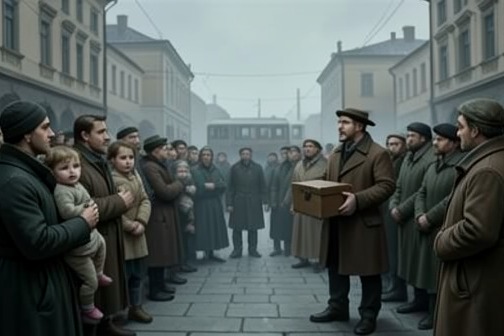
The [Deportation of children and elderly people from the Łódź Ghetto](entity:event-recall-event-3d1390e5a8ec) is recalled through an announcement that divided families by age: adults over sixty-five and children under ten were to be surrendered for deportation. The account makes the threat both intimate and starkly administrative, then registers how hunger could abruptly displace even this catastrophe from public conversation.
## The account and its setting
The episode reaches [Paul Doll](entity:character-recall-character-paul-doll-263bff157203) during a three-hour delay in the arrival of a transport from [Theresienstadt camp](entity:location-recall-location-711f88de9304), caused by the non-appearance of the disinfectors. Doll falls into conversation with a middle-aged industrial engineer, formerly a member of the Jewish Council in Lublin. The man’s daughter and her children are with him. Doll reassures them about ample meals and snug lodgings at the camp; the engineer then takes Doll aside and tells him what has happened in the Łódź Ghetto. The framing places the story beside Doll’s own assurances to new arrivals, sharply separating what he tells the family from the terrible account he receives.
The event is presented as a story about the power of hunger. Its first concrete scene is September 4, when a thick crowd gathers on Fireman’s Square. [Chaim Rumkowski](entity:character-recall-character-chaim-rumkowski-7c623390473f), weeping, announces the latest German demand: all adults over sixty-five and all children under ten must be surrendered for deportation. The account turns immediately to the next day, when the old are to go and the young are to go. It conveys the imminence of the separation, but gives no further account of the deportees’ journey or eventual fate.
## The announcement and its immediate aftermath
The German demand reaches the crowd through Rumkowski, whose tears register the human cost of conveying it. The policy’s age boundaries make the threat especially legible: the targeted groups are the elderly and the very young, people whose removal also means the forced separation of children from families. The account does not describe a negotiation or a means of escape; it presents the demand as something the ghetto’s inhabitants are told to meet.
That afternoon, news arrives that potatoes are ready for distribution. Euphoria surges through the streets, and conversation and thought turn from the disappearance of the elderly and children to the potatoes. The shift does not mean the deportation has been called off or that the danger has passed. Instead, the sudden change in focus gives hunger its own force in the scene: the prospect of food can momentarily take precedence over the impending removal of loved ones. The account’s contrast is not between suffering and relief, but between two urgent forms of deprivation.
## The wider policy context
A later discussion in [Berlin](entity:location-recall-location-berlin-54cb4a75d0f6) places this episode within the development of Nazi mass murder, without establishing the specific chain of orders behind the Łódź demand. [Professor Entress](entity:character-recall-character-professor-entress-fdce3fbcfcd0) describes July 31, 1941, as a decisive point: a letter drafted by Eichmann and [Reinhard Heydrich](entity:character-recall-character-reinhard-heydrich-3a78d0693532), sent to Goring and returned with his signature, authorized action in accordance with Hitler’s wish for a total solution. Entress says that the leadership may initially have contemplated expelling Jews to a remote, cold region after victory over [Russia](entity:location-recall-location-russia-8ee8be401081). As that territorial answer receded and officials in occupied [Poland](entity:location-recall-location-poland-919a7f7f62ac) faced the number of Jews under their control, pressure mounted; by August or September, the policy had crossed a threshold from killing men to killing women and children as well.
Entress also argues that the industrial character of the killing was not its essential condition. Gas chambers and crematoria, in his account, accelerated the process, economized on resources, and spared the killers’ nerves; bullets and pyres could have served the same murderous will. He cites the [Einsatzgruppen](entity:organization-recall-organization-einsatzgruppen-d4b9bd17f4e9)’s killing of well over a million people by bullets. This retrospective analysis illuminates the broader context in which the targeting of children and elderly people must be understood, while leaving the exact operational circumstances of the Łódź announcement unspecified.
## Bureaucratic priorities and human consequences
Doll’s reflections elsewhere expose a conflict within the machinery governing deported people. The [Economic Administration Head Office](entity:organization-recall-organization-86ca0fe228fe) presses him to increase labor strength for the munitions industries, while the Reich Central Security Department presses for the disposal of evacuees. Doll reads a proposal from Gerhard Student to work able-bodied mothers to exhaustion in the boot factory at Chełmek and objects that its proponents have not considered the consequences of separating mothers from their children. This is not presented as part of the Łódź episode itself; it is a parallel example of how competing administrative demands bear down on families.
Together, the accounts resist reducing deportation to a single bureaucratic decision or to a process made comprehensible by its industrial methods. The order reported at Fireman’s Square is encountered through its immediate human division, while the potato distribution shows how hunger shapes what people can attend to from one moment to the next. The story’s restrained sequence—crowd, announcement, threatened departure, food—makes the policy’s violence visible without supplying details beyond the testimony it preserves.
Event 11
Beer Hall Putsch
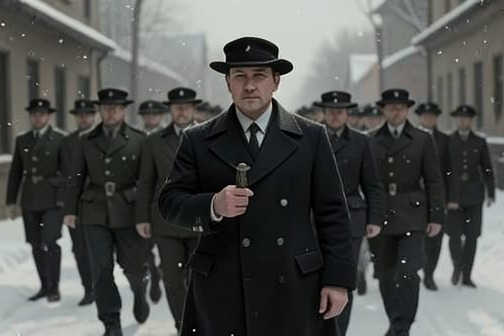
The [Beer Hall Putsch](entity:event-recall-event-c5c33b7ae93e) is recalled during [Paul Doll](entity:character-recall-character-paul-doll-263bff157203)’s [November 9](entity:time-recall-time-11-9-e9d98101185c) memorial ceremony, where a failed 1923 revolt becomes a story of national martyrdom. The episode matters less as a straightforward account of the coup than as a demonstration of how Doll turns defeat into patriotic myth: his solemn pageant of heroic sacrifice is punctured by the narrator’s precise, almost grotesquely ordinary details about the marchers, their uniforms, and their pay.
## The Putsch as a Memorial Story
Doll invokes November 9 as a day of threefold significance for the Nazi movement. He links it to the 1918 revolution and to the 1938 pogrom, presenting both through antisemitic claims that transform political defeat and state-organized violence into stories of Jewish provocation. He then announces that his true subject is November 9, 1923, and the Putsch. By placing the failed uprising inside this invented sequence of injuries and vindications, Doll makes a political reversal sound like a sacred inheritance.
His performance takes place at a memorial gathering, not in a neutral historical account. He is visibly not wholly sober, but has measured his drinking; liquor has warmed him and deepened his voice. From beneath the sloping wooden lectern he produces a large glass of colourless liquid, which gives off a faint vapour. His ceremonial manner makes the past seem present and holy, while the details surrounding the speech disclose the unstable, theatrical conditions of its telling.
## The March on [Munich](entity:location-recall-location-munich-a2858688fbfd)
The narrator’s account reduces the grandeur of Doll’s language to a specific crowd and route. About 1,900 men gathered in and around the Bürgerbräukeller in Munich: tub-thumpers, militiamen, storekeepers, students, and other disaffected men, of different ages and backgrounds, armed and wearing ill-fitting brown uniforms. Each had been paid two billion marks, equivalent on that day to three dollars and four or five cents. At the appointed hour they emerged from the beer cellar and began moving toward the Feldherrnhalle, the first stage, in their plan, of a revolutionary march on [Berlin](entity:location-recall-location-berlin-54cb4a75d0f6).
Doll describes the marchers as grave yet joyful, iron-willed but carefree, moved by the crowd and inspired by Mussolini’s march on Rome. In his version they joke and sing even as they jeer at the carbines of the Republican State Police. The narrator’s description offers no comparable grandeur: an assortment of armed men, in badly fitting uniforms, set out from a cellar on a revolutionary venture. This contrast does not erase the march’s violence; it shows how the memorial speech converts a disorderly political gamble into a polished scene of collective destiny.
## Gunfire and the Heroic Version
The march ends in gunfire. Doll’s account moves from a shot to a volley and then a fusillade. General Erich von Ludendorff presses forward in righteous fury; Goring is badly wounded in the leg. The future Reich leader, whom Doll calls the Deliverer, is said to have braved the bullets with two broken arms to carry a helpless child to safety. When the gun smoke clears, Doll declares, fourteen men dead: fourteen brothers and warrior-poets, leaving fourteen widows and sixty fatherless children. He makes their deaths the foundation of the hope and rebirth he claims the gathering is honouring.
These details belong to Doll’s staged retelling, and his diction steadily raises the dead from participants in a failed uprising into sacrificial heroes. The narrator’s account and Doll’s speech therefore do different work: one names the crowd, its meeting place, its numbers, and its route; the other arranges the violence into a consoling legend. The speech’s insistence on sacrifice is especially pointed because the historical outcome it commemorates is defeat, not victory.
## Political Memory and the Later Narrative
The ceremony’s use of the Putsch sits beside a broader account of Nazi political violence. In a later conversation in the [Tiergarten](entity:location-recall-location-64942ec92484), [Professor Entress](entity:character-recall-character-professor-entress-fdce3fbcfcd0) argues that industrial killing was not the source of the will to exterminate: gas chambers and crematoria accelerated the process, economised its operation, and spared the killers’ nerves, but bullets and pyres would ultimately have served the same purpose. He cites the [Einsatzgruppen](entity:organization-recall-organization-einsatzgruppen-d4b9bd17f4e9)’s killing of well over a million people by bullets. That analysis does not make the 1923 march the cause of later mass murder; it places Doll’s celebration of armed political violence within a narrative that insists on the consequences of political will, whatever the means used to enact it.
The Beer Hall Putsch’s memorial meaning is thus exposed as an act of selective remembrance. Doll dwells on the dead as proof of national virtue, while the narrative makes the audience hear both the embellishment and the historical cost obscured by such ceremonies. The speech tries to seal defeat inside a story of rebirth; the surrounding account leaves that story open to judgment.
Event 12
Kristallnacht
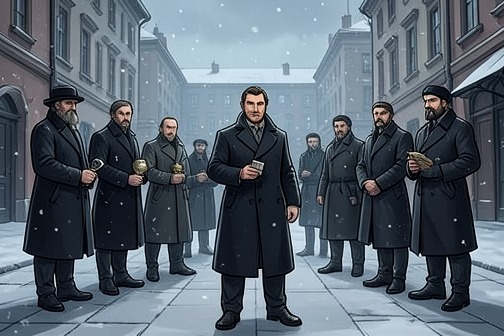
[Kristallnacht](entity:event-recall-event-57c2b9beff84) is remembered in the novel through a [November 9](entity:time-recall-time-11-9-e9d98101185c) memorial address by [Paul Doll](entity:character-recall-character-paul-doll-263bff157203), who presents the 1938 anti-Jewish violence as a spontaneous German uprising rather than state persecution. The gap between that claim and the grotesque ceremonial setting makes the speech a study in how political ritual can disguise violence as national injury and justice.
## The event in Doll’s account
Doll names November 9, 1938, as the date of Kristallnacht and places it among three supposedly sacred anniversaries for the Nazi movement. He links it to November 9, 1918, which he describes through an antisemitic conspiracy about the surrender of [Germany](entity:location-recall-location-germany-2e3723c2f347), and to the failed 1923 putsch. His account of 1938 begins with the cowardly murder of the German ambassador in Paris by Herschel Grynszpan, then claims that the German people rose spontaneously in search of justice after years of provocation. That is Doll’s justification, not a neutral account: it turns anti-Jewish violence into a story of popular self-defence and suppresses the persecution at its centre.
## The memorial performance
The speech takes place at a November 9 gathering that Doll calls the Reich Day of Mourning. In bitter cold, before a standing audience, he reaches for a typescript and announces the date as if the heavens themselves were mourning. Fourteen wreaths lean against fourteen tar-blackened flowerpots serving as urns. The arrangement gives the ceremony the appearance of solemn remembrance, while its setting within the camp and its speaker’s political language expose the violence beneath that display.
Doll calls the date a holy day of threefold importance and moves between grievance, sacrifice, and rebirth. Later he raises the [Blood Flag](entity:object-recall-object-d8ec0b133d78), explaining its symbolic stain as red wine and comparing its transformation to the Eucharist. By bringing religious language and an emblem of political martyrdom into the memorial, he makes the movement’s version of history feel sacred. Yet the performance is unstable: Doll is not wholly sober, and the narrator watches him falter as the speech continues. The scene presents ritual not as proof of the story Doll tells, but as a means of giving that story authority.
## Memory, distortion, and the wider history
The novel does not stage the violence of Kristallnacht itself in these passages. Instead, it shows how the event is appropriated afterward: Doll’s speech makes the murder of the ambassador a pretext, portrays the attacks as spontaneous, and turns the date into a celebration of national sacrifice. The form matters. Readers encounter the event through an address delivered at a state memorial, filtered through Golo Thomsen’s observation of Doll and the ceremony, rather than through a direct account of the victims’ experience.
Elsewhere, the novel places this commemorative rewriting beside a later discussion of the mass murder of Europe’s Jews. [Professor Entress](entity:character-recall-character-professor-entress-fdce3fbcfcd0) traces the authorization for a total solution to a letter dated July 31, 1941, and describes a subsequent turn toward killing women and children as well as men. He argues that gas chambers and crematoria made killing faster and spared the killers’ nerves, but were not necessary to the underlying murderous intent: bullets and pyres could have served it. This later analysis does not establish Kristallnacht as a direct cause of the subsequent policy. It does, however, sharpen the contrast between Doll’s sanitized tale of spontaneous justice and the novel’s account of an expanding system of deliberate persecution and murder.
Event 13
The Reichstag Fire and the repression that followed

[The Reichstag Fire and the repression that followed](entity:event-recall-event-d59ef4576ab7) are presented as the hinge between Nazi political ascendancy and open dictatorship. The fire, on [February 27, 1933](entity:time-recall-time-1933-2-27-bd5711afe53b), supplies the pretext [Paul Doll](entity:character-recall-character-paul-doll-263bff157203) says the regime used to outlaw all opposition; by March, thousands of leftist notables have been arrested, tortured, and imprisoned. Its consequences reach into private life as well as public politics: [Dieter Kruger](entity:character-recall-character-dieter-kruger-1afea31a0f8f) is among the prisoners sent to [Dachau](entity:location-recall-location-dachau-577a13cf948f), where Doll is one of his jailers. In Doll’s retrospective telling, political emergency becomes both a historical explanation and an alibi, making the fire’s cause and the repression it enables inseparable from the stories perpetrators tell about themselves.
## The Fire as a Political Turning Point
Doll looks back on the fire as the moment when the path to autocracy became clear. He rejects both the familiar account of a confused lone Dutch Communist setting the blaze and the possibility that the Nazis started it themselves. Instead, he attributes it to destiny and providence, even describing the [Reichstag](entity:location-recall-location-c01fad9df826) as having been torched by God. The explanation does not establish what caused the fire; it reveals Doll’s way of turning a political catastrophe into a sacred inevitability. His account erases human agency precisely where agency matters most, even as he openly describes what the authorities did next.
That next step, in Doll’s formulation, was simple and decisive: after the fire, the regime made all opposition illegal. By March 1933, four thousand leftist notables had been arrested, tortured, and imprisoned. The progression from a blaze in the parliament building to mass repression is narrated not as a temporary response but as the opening of an unobstructed road to autocracy. The political significance lies in that conversion of emergency into durable rule: the fire supplies the occasion, while the destruction of opposition supplies the lasting consequence.
## Arrests and the Personal Reach of Repression
The campaign reaches Dieter Kruger among the thousands caught in the arrests. [Hannah Doll](entity:character-recall-character-hannah-doll-2c2e53cda395) recalls that, in March 1933, he was arrested, tortured, and imprisoned; he was then sent to Dachau. There, Corporal Doll was among his early jailers. The political consequences thus enter the novel through an intimate triangle of people whose lives are altered by the new power: Hannah remembers Dieter’s imprisonment, while Doll’s own retrospective account places him inside the apparatus that confined him.
The connection is not merely a matter of a future commandant passing through a historical scene. In a later recollection, Doll describes the arrest of opposition as the moment when the regime’s political opportunity opened, and his account of Dachau places him on the side of those who enforced it. The fire’s aftermath therefore has a personal duration: it does not end with the arrests of March 1933. It places political prisoners under the control of men such as Doll and establishes a setting in which detention and violence become instruments of rule.
## From Emergency Rule to Expanding Bureaucracy
The novel’s later accounts do not claim that the Reichstag Fire directly dictated every subsequent Nazi policy. Instead, they show how the repression that followed belongs to a regime whose institutions and officials repeatedly turn political objectives into administrative decisions. In a later reflection on the mass murder of Europe’s Jews, Doll recounts a July 1941 authorization drafted by Adolf Eichmann and [Reinhard Heydrich](entity:character-recall-character-reinhard-heydrich-3a78d0693532), sent to Hermann Goring, and returned with his signature. He describes a change from proposals to remove Jews to the decision to kill women and children as well as men. This later episode is distinct from the 1933 arrests, but it places the earlier destruction of political opposition within a longer history of state power expanding its reach.
A conversation with [Konrad Peters](entity:character-recall-character-konrad-peters-3375e9a11977) further resists the idea that later killing depended on one particular technology. Peters calls gas chambers and crematoria means of accelerating the process, saving resources, and sparing the killers’ nerves; he insists that bullets and pyres could have produced the same outcome because the perpetrators had the will. The reflection shifts attention from machinery to intention. Read alongside Doll’s account of the fire, it marks a grim continuity: institutions may change their procedures and scale, but explanations that make violence seem necessary or inevitable obscure the choices made by those carrying it out.
## Retrospective Narration and Historical Irony
The account is shaped by retrospective narration, especially Doll’s effort to claim authority over what the fire meant. His providential explanation conflicts with the concrete political result he describes: the regime outlawed its opponents and arrested thousands. The mismatch makes his version unreliable as an account of cause, while making it revealing as an account of perpetrator self-justification. Destiny takes the place of responsibility in his explanation; the steps taken by the authorities immediately afterward remain visible.
The book also returns to political memory through ritual. At a later [November 9](entity:time-recall-time-11-9-e9d98101185c) commemoration, Doll delivers a speech that links different dates to the movement’s self-image and presents its history through grievance, sacrifice, and sacred symbols. That ceremony is not part of the fire’s immediate aftermath, but it echoes Doll’s earlier habit of recasting political events as providential history. Against these performances, the account of arrests, torture, imprisonment, and Dachau supplies a less flattering measure of what the regime’s claims of destiny accomplished. The fire matters not only as a turning point in the consolidation of power, but as a test of the stories by which that power is made to appear ordained.
Event 14
Chełmno “silent boys” massacre
The [Chełmno “silent boys” massacre](entity:event-recall-event-4e471609a83a) was the killing of a hundred Jewish teenagers whom the [SS](entity:organization-recall-organization-d352e2475f65) and Orpo forced to assist with burying victims on January 21, 1942. After a day of labor in the snow, without food or water and under the lash, the boys were taken to the pits and murdered. The account makes their silence—not an absence of violence, but its terrible accompaniment—the event’s defining image.
## Background and Setting
The massacre took place at [Chełmno](entity:location-recall-location-che-mno-fd777d013df9) amid an ongoing operation in which three gassing vans repeatedly traveled from the Schlosslager to the Waldlager, unloaded bodies, and returned. The work of handling the dead fell to [Sonderkommando prisoners](entity:concept-recall-concept-d41d95e727bf). On January 21, the number of victims was so great that the SS and Orpo selected another hundred Jews to help drag the bodies to a mass grave. The narrative identifies this additional group as teenage boys.
The wider policy context described in the book reaches back to July 31, 1941, when a letter drafted by Eichmann and Heydrich was sent to Goring and returned with his signature, authorizing a “total solution.” The account describes an earlier possibility of deporting Jews to a remote, cold region, and a subsequent turn toward killing women and children as that territorial option receded and pressure mounted among officials in [Poland](entity:location-recall-location-poland-919a7f7f62ac). This context situates the massacre within an expanding policy of extermination; it does not present the boys’ murder as an isolated act.
## Forced Labor and Murder
The boys were made to work from five in the morning until five in the evening. They received no food or water and labored for twelve hours naked in snow and hardened mud, under the lash, dragging bodies to the mass grave. The account gives the labor a stark duration and physical setting rather than reducing it to an abstract number of victims.
As the light thinned, Major Lange led the boys to the pits and shot them one by one. When he ran out of ammunition, he used the butt of his pistol to smash their skulls. The boys jostled to be next in line, yet none made a sound. The sequence moves from forced participation in disposing of the dead to their own systematic killing, carried out by the same machinery of violence.
## Sound, Silence, and Witness
The recollection insists on what could be heard: wind in the trees, the use of whips, and the gassing vans moving between the two camps. The killing of the boys, too, was audible; the narration repeats that one could hear it even as it records their refusal or inability to cry out. The contrast makes silence neither peaceful nor consoling. It marks the extremity of what was done to them.
The phrase “the time of the silent boys” first seems to offer a bleak explanation for the scene’s cold and stillness, but the narrative immediately refuses to let the weather contain its meaning. The wind, the whips, the vans, the shots, and the blows all remain in the account. Their silence is therefore preserved not as a gap in the record but as the fact a witness must carry forward.
## Policy and Narrative Significance
Elsewhere, the book’s account of the extermination policy stresses that gas chambers and crematoria accelerated killing and reduced the strain on the killers, but were not necessary to the intention to murder. Bullets and pyres, it argues, could have served the same end. At Chełmno, the gassing vans and mass grave belong to an organized process; the murder of the boys shows how that process also compelled victims to perform labor before killing them.
The massacre is narrated as a remembered event by [Angelus Thomsen](entity:character-recall-character-angelus-thomsen-4d6c7ca47636). Its precise date, the twelve-hour shift, and the boys’ silence anchor the scene in concrete details, resisting any account that would blur the victims into an anonymous mass. In the recurring phrase “the time of the silent boys,” memory gives the murdered teenagers a distinct place in the narrative: their silence becomes evidence of violence, not evidence that nothing happened.
Event 15
Paul Doll's November 9 memorial ceremony
[Paul Doll's November 9 memorial ceremony](entity:event-recall-event-11-9-0c325f31f314) is an outdoor ritual in which a camp commandant converts Nazi political history into a pageant of mourning, sacrifice, and sanctified violence. Seen by [Angelus Thomsen](entity:character-recall-character-angelus-thomsen-4d6c7ca47636), the ceremony’s wreaths, ersatz urns, and [Blood Flag](entity:object-recall-object-d8ec0b133d78) lend solemn form to a speech that distorts the past; the snow stained by the nearby pyre and smokestacks makes the performance’s distance from the dead impossible to keep secure.
## Conception and Setting
The idea takes shape at night, after Angelus Thomsen and [Wolfram Prufer](entity:character-recall-character-wolfram-prufer-78c6cf90445d) have seen the yellow eye of a second train. Thomsen proposes making a special effort for [November 9](entity:time-recall-time-11-9-e9d98101185c): not merely a ceremony, but a proper commemoration accompanied by a stirring speech. Prufer asks whether it should be held in the church. Thomsen rejects that possibility in favor of an outdoor gathering, invoking the example of the Old Fighters, who had acted in the open air. When Prufer points out that their example belongs to [Munich](entity:location-recall-location-munich-a2858688fbfd), far from East [Poland](entity:location-recall-location-poland-919a7f7f62ac), Thomsen dismisses the difference in latitude and accepts the prospect of snow. Tarpaulins can be strung up near the orchestra stand, he says; the cold, he suggests, will stiffen morale.
The choice of setting makes the ceremony part of the landscape rather than an occasion safely enclosed from it. When it takes place, the temperature is minus fourteen Celsius. Snow, brown from the pyre and smokestacks, falls over the assembled officers and guests. Thomsen, [Boris Eltz](entity:character-recall-character-boris-eltz-8a6f6c87ec3a), and [Hannah Doll](entity:character-recall-character-hannah-doll-2c2e53cda395) stand bundled in layers thick as mattresses, among an audience divided on either side of an aisle. The scene’s natural details do not remain neutral decoration: the smoke-darkened snow accompanies a ritual that tries to make political killing look like honorable sacrifice.
## The Public Ritual
[Paul Doll](entity:character-recall-character-paul-doll-263bff157203) walks slowly down the aisle and climbs onto a low stage. Before the banner-draped podium stand fourteen wreaths arranged beside fourteen supposed urns, which are in fact flowerpots blackened with tar. Doll halts in front of this improvised memorial, reaches into his greatcoat, and produces a large typescript. His ceremonial appearance is unstable from the outset. He is not wholly sober, though he has apparently taken enough care with his drinking to steady himself and deepen his voice. From beneath the sloped podium he takes a large glass of colorless liquid, faintly steaming in the cold.
Doll calls November 9 a day of threefold importance to the Nazi movement, then makes the dates serve a fabricated political history. He associates November 9, 1918, with an alleged Jewish betrayal of [Germany](entity:location-recall-location-germany-2e3723c2f347), describing the end of the war as a financial conspiracy. He presents the November 1938 pogrom, [Kristallnacht](entity:event-recall-event-57c2b9beff84), not as state-organized antisemitic violence but as a spontaneous popular rising provoked by the murder of a German ambassador in Paris. The speech’s account turns persecution into self-defense and assigns responsibility to its victims.
His main subject is November 9, 1923, the failed [Beer Hall Putsch](entity:event-recall-event-c5c33b7ae93e). Doll recasts the armed marchers as cheerful, iron-willed, and emotionally noble, borrowing the image of Mussolini’s march on Rome to make their defeat seem the beginning of a destiny. In his version, the marchers continue despite jeers and police carbines; Ludendorff presses forward after the shooting begins, Göring is gravely wounded, and [Adolf Hitler](entity:character-recall-character-adolf-hitler-e6e3f1777476) braves the bullets to rescue a child. Doll presents the fourteen men killed as brothers and warrior-poets whose deaths gave later generations hope. The remembered failure is thus reshaped into a founding martyrdom, with the ceremony’s fourteen wreaths supplying a visible counterpart to his repeated count of fourteen dead.
## Symbols, Witnesses, and Interruption
As the brown snow thins and abruptly stops, Doll looks upward with gratitude. The brief pause gives way to another emblematic gesture: he unfurls the Blood Flag, claiming that its symbolic stain is red wine and likening its transformation to the Eucharist. The comparison gives a political relic the language of sacred ritual. But the scene does not become a shared act of reverence. Hannah turns her gaze forward and clamps a mittened hand to her nose; Angelus Thomsen, after looking toward Boris and then toward Hannah, struggles with pressure in his chest and tries not to follow Doll’s voice as it continues through an inventory of medals, rings, coats of arms, torches, chants, oaths, and shrines.
Near the end, Doll presents himself as a man overcome by grief and pride, kisses the flag, and announces that the assembly will sing the [Horst-Wessel-Lied](entity:expression-recall-expression-horst-wessel-lied-e2424a955e64) and [Ich hatt’ einen Kameraden](entity:expression-recall-expression-ich-hatt-einen-kam-0d84c004d072) after a three-minute silence for each fallen Old Fighter. He begins the silence by naming Claus Schmitz. Only ten or twelve seconds pass before a diagonal blast of hail interrupts it. The weather breaks into the ceremony’s carefully controlled solemnity before the silence can run its announced course.
The gathering does not conclude in public mourning. It is followed by an immediately and thoroughly drunken lunch in the Officers’ Club. After half an hour, Doll is lying flat on a deep settee. Music plays and some people dance. Thomsen and Hannah keep their distance, yet he senses that both remain intensely aware of one another. Their inward attention to each other sits beside the room’s sentimental songs and the officers’ drinking, making the aftermath less a resolution than an uneasy return to private feeling and routine.
## Commemoration and the Violence It Conceals
The ceremony’s central act is the conversion of political violence into a story of noble loss. Doll’s rhetoric places the Nazi movement among the bereaved, while its imagery—the wreaths, the nominal urns, the flag, the prescribed songs—gives that claim a public, repeatable form. Its distortions are not incidental to the performance: the false description of Kristallnacht as spontaneous justice and the heroic retelling of the Beer Hall Putsch present aggression as victimhood and defeat as martyrdom.
The wider narrative supplies a counterpressure to this pageant. Elsewhere, Thomsen describes being caught between officials urging him to expand labor for the munitions industries and security authorities pressing for the disposal of evacuees. Later, [Konrad Peters](entity:character-recall-character-konrad-peters-3375e9a11977) locates a decisive turn in the authorization issued on July 31, 1941, and in the subsequent extension of killing from men to women and children. Peters also argues that gas chambers and crematoria accelerated the process and reduced the strain on the killers, but that bullets and pyres would have served the same murderous purpose. These reflections do not form part of Doll’s speech; their juxtaposition with the ceremony exposes the gap between official memorial language and the mass violence that the regime’s administrative machinery enabled.
Thomsen’s response remains divided. At the ceremony he is both witness to Doll’s theatrical performance and a man unable to detach himself from Hannah’s presence or from the physical pressure the speech produces. The storm of hail and the drunken lunch interrupt the ritual’s claim to solemn closure, but do not undo it. The event’s significance lies in that unresolved contrast: a regime stages remembrance for its own dead while the surrounding world of forced labor, deportation, and killing presses through the ceremony’s symbols.
Event 16
German invasion of the Soviet Union

The [German invasion of the Soviet Union](entity:event-recall-event-3882b8eb60a7) appears not as a self-contained military episode but as the point where Nazi confidence, imperial ambition, and mass murder converge. Recalled by [Angelus Thomsen](entity:character-recall-character-angelus-thomsen-4d6c7ca47636) and reconsidered by [Boris Eltz](entity:character-recall-character-boris-eltz-8a6f6c87ec3a), the campaign changes in retrospect from an apparently winning gamble into a war whose violence could not secure victory—and whose eastward expansion coincided with decisions to kill Jewish women and children as well as men.
## Origins and Assumptions
Boris describes the decision to invade as an extension of the confidence that followed France’s defeat. He recalls that he had supported the invasion at the time, swept up in the belief that no one could refuse [Adolf Hitler](entity:character-recall-character-adolf-hitler-e6e3f1777476) after the rapid victory in France. The generals, in Boris’s account, regarded an attack on [Russia](entity:location-recall-location-russia-8ee8be401081) as potentially insane, but the French campaign had made Hitler seem like a leader whose instincts would again prevail. Boris’s retrospective judgment does not excuse his earlier enthusiasm: he explicitly includes himself among those who endorsed the decision.
The invasion was also joined, in Boris’s account, to [Nazi antisemitism](entity:concept-recall-concept-cd533617b822). He describes the leadership’s willingness to pursue Hitler’s “fever dream about the Jews” alongside the military campaign. The juxtaposition makes the eastern war more than a bid for territory: conquest and racial persecution travel together in the political imagination that Boris remembers. His later disgust at the decision therefore marks a change in judgment, not a claim that he had opposed its aims from the beginning.
## A Campaign Recast as a War of Annihilation
Boris’s assessment turns on a distinction between a conventional military campaign and a war of pillage and murder. At first, he says, the violence seemed effective; until around late September, the invasion still looked viable to him. He acknowledges that he had believed a war of annihilation was “doing the trick,” a phrase that exposes how success could be measured through mass death. Yet his confidence had depended on treating murder as a means capable of overcoming the realities of a vast country and its population.
He gives the scale of that miscalculation in stark arithmetic. Even if [Germany](entity:location-recall-location-germany-2e3723c2f347) killed five million people, took five million prisoners, and starved another thirty million, he argues, 125 million would still remain. Destroying Leningrad and Moscow would not end resistance: he anticipates an insurgency extending along the Urals and asks how Siberia, described as the size of eight Europes, could be pacified. The figures do not turn his argument into a humane rejection of mass violence; they reveal the strategic limits he eventually sees in the attempt to subdue a population through it.
Boris contrasts the invasion with an older, conventional cabinet war against a dying regime. This campaign, he argues, was different because every Russian might fight, including women and children. He locates his own change of mind in the course of the advance: until October and the events at Kiev, he had believed that murder and massacre could accomplish what ordinary military force could not. He then admits that he had thought “night” was winning. His language registers a collapse of certainty: the violence had seemed not merely permissible to him but capable of delivering an outcome, until the campaign made that belief untenable.
## Military Reversal and Belated Recognition
The invasion’s failure becomes legible in the conversation through Boris’s reassessment of the war’s prospects. He insists that victory against Russia was impossible, and argues that declaring war on America after the campaign had bogged down compounded the regime’s errors. He points to the possibility of a Russian insurgency even if major cities were razed, and to the inability of an occupying force to pacify the immense territory beyond them. These are Boris’s judgments, presented in a private conversation rather than as a detached account of military operations; their force comes partly from the fact that he had once been an advocate of the invasion.
Angelus initially answers with the absence of a second front, the possibility of a break between the Allies and Moscow, and Germany’s hoped-for “wonder weapons.” Boris counters that the opposing side also has German scientists. The exchange preserves the distance between recognition and acceptance: even while Boris says Germany has lost, Angelus reaches for reasons the outcome might still be reversed. The invasion’s decisive consequence in this conversation is thus also a shift in what the characters can admit about the war.
## Invasion and the Radicalization of Mass Murder
The novel places the invasion alongside a developing policy of extermination without reducing that policy to a single battlefield decision. In a later account to Thomsen, [Konrad Peters](entity:character-recall-character-konrad-peters-3375e9a11977) traces what he calls the crime without a name to an authorization dated July 31, 1941, when Nazi power was at its height. He describes a letter drafted by Adolf Eichmann and [Reinhard Heydrich](entity:character-recall-character-reinhard-heydrich-3a78d0693532), sent to Hermann Göring and returned with Göring’s signature, granting authority to pursue a total solution. This account places a high-level authorization within the period of the war in the east, while making clear that the process continued through further decisions and pressures.
Peters describes an initial possibility of deporting Jews to a cold, barren region beyond the Urals and into the Arctic Circle, where they would die through exposure and deprivation. As a quick victory over Russia receded, he says, territorial removal appeared less feasible. At the same time, officials in [Poland](entity:location-recall-location-poland-919a7f7f62ac) faced pressure after the annexation of millions more Jews and struggled to manage the numbers. Peters identifies August and September as a further turn: the killing of men, already under way for months, was extended to women and children. The invasion’s stalled progress and the shrinking prospect of removing Jews eastward form part of this account of escalating policy, rather than a claim that military reversal alone explains the genocide.
Peters also rejects the idea that the industrial machinery of killing was essential to the perpetrators’ intention. Gas chambers and crematoria, he argues, made mass murder faster, more economical, and less damaging to the killers’ nerves; they were methods, not the source of the will to kill. He points to the [Einsatzgruppen](entity:organization-recall-organization-einsatzgruppen-d4b9bd17f4e9) and their killings by bullets to insist that murder could have continued by other means. In the novel’s treatment, the invasion is therefore bound to extermination not because one technology or one order created the violence, but because the campaign’s expansion, administrative pressures, and changing territorial calculations accompany a widening determination to murder. Boris’s belated recognition of military failure and Peters’s account of policy formation expose two connected limits of the regime’s vision: conquest cannot make a vast population disappear, and the failure of one method does not extinguish the intent to kill.
Event 17
Battle of Stalingrad and German surrender
The [Battle of Stalingrad and German surrender](entity:event-recall-event-47eaf7c3bd7d) mark the moment when the official story of inevitable German victory collides with news of encirclement, starvation, defeat, and capitulation. The reversal is presented through [Paul Doll](entity:character-recall-character-paul-doll-263bff157203), whose reliance on propaganda makes him both a witness to the facts and an agent of their denial: he celebrates a coming victory, repeats assurances of relief, and then struggles to absorb the truth that the 6th Army surrendered rather than dying in the heroic last stand he had been told to imagine.
## Victory before the reversal
As autumn turned toward winter, Doll treated the eastern campaign as proof that [National Socialism](entity:concept-recall-concept-national-socialism-2a8314dfe38e) had been vindicated. He recalled a major oration in which [Adolf Hitler](entity:character-recall-character-adolf-hitler-e6e3f1777476) claimed that the stronghold on the Volga was roughly three-quarters overrun and predicted that the city would fall within the month. The prediction was already too optimistic, but Doll remained certain that German forces would raise the swastika over the ruins by [Christmas](entity:time-recall-time-0cffe7da2c4d). He framed the expected conquest as an inevitable victory and praised [Friedrich Paulus](entity:character-recall-character-friedrich-paulus-84bd2b287a45) and the 6th Army, while endorsing the reported plan to deport the women and children who remained and shoot the men. The military campaign and the intended fate of the city’s population thus appeared together in his account: conquest was imagined not as a limited battlefield success, but as domination accompanied by racial violence.
That certainty existed alongside competing demands within the Nazi system. At the camp, Doll felt caught between the [Economic Administration Head Office](entity:organization-recall-organization-86ca0fe228fe), which pressed him to increase the labor force for the munitions industries, and the Reich Central Security Department, which demanded the removal of as many evacuees as possible. He resented a proposal to work able-bodied mothers in a boot factory, insisting that its author should try separating mothers from their children at the arrival ramp. This conflict does not explain the military outcome at [Stalingrad](entity:location-recall-location-stalingrad-1719b42dce49), but it reveals the wider regime in which the battle was being fought: people were counted at once as exploitable labor and as targets for expulsion and murder.
## Encirclement and the failure of assurances
As news from the front became harder to ignore, Doll turned to his subordinates for information. The [Volksempfänger radio](entity:object-recall-object-volksempf-nger-c1aec71becca) offered little useful detail; the silence from [Berlin](entity:location-recall-location-berlin-54cb4a75d0f6) itself began to trouble him. [Wolfram Prufer](entity:character-recall-character-wolfram-prufer-78c6cf90445d), ordinarily an unimpressive commander, seemed a more promising source because his brother Irmfried served on Paulus’s staff and mail was still reaching and leaving Stalingrad as Christmas approached. Prufer reported dire conditions in guarded, contradictory terms. There was hardly any fuel or food; the troops were eating horses, then had exhausted their supply of cats. Temperatures had fallen to thirty degrees below zero, disease spread while medicine ran short, lice were a problem, and ammunition was running out. Irmfried had frostbite so severe that he did not feel a mouse gnawing through his bedsocks and eating his toes.
Prufer nevertheless maintained that hardship could not defeat German soldiers. He described the German ranks as impregnable, then conceded that, if he were [Georgy Zhukov](entity:character-recall-character-georgy-zhukov-4ca416022b89), he would attack the Romanian forces. He also insisted that Manstein would break through with six divisions and turn the situation around, even if the German forces were technically surrounded. Doll answered these reports not by revising his expectations, but by repeating the premise that defeat was a biological impossibility. The exchange makes the denial visible in its working form: concrete evidence accumulates, yet each fact is absorbed into a vocabulary of temporary privation, military superiority, and promised rescue.
The assurance collapsed when [Fritz Mobius](entity:character-recall-character-fritz-mobius-e3c937040e4e) reported that Manstein had been turned back and was retreating after being mauled fifty kilometres to the west. Doll tried to maintain his authority as commandant, speaking confidently about Paulus taking the necessary measures to avoid encirclement. Mobius corrected him: Zhukov had already broken through the Romanian lines, and the German army was trapped. The correction came after Doll had privately received misleadingly reassuring accounts and after he had made confidence part of his public posture. Soon afterward, the Volksempfänger described the 6th Army’s position as a heroic stand in the Caucasus and compared it to the Spartans at Thermopylae. Doll’s own question—whether the Spartans had all been killed—registers the gap between the radio’s exalted analogy and the likely fate concealed by it.
## Capitulation against the official story
The radio continued to report that the last German fighters were raising their hands to sing national anthems, presenting their final moments as a heroic sacrifice. Doll listened to a recording of [Joseph Goebbels](entity:character-recall-character-joseph-goebbels-e38487c8d7d7)’s Sportpalast address of February 18 and read an editorial claiming that the soldiers had died so [Germany](entity:location-recall-location-germany-2e3723c2f347) might live. The minister’s call for total war and the newspaper’s account of noble death offered a ready-made interpretation of Stalingrad: sacrifice, rather than defeat, was to be the public meaning of the battle.
Mobius broke that account open. When Doll invoked the honor of a man who lays down his life, Mobius told him that the soldiers had not died in a final act of resistance; they had surrendered. Doll’s first response was disbelief. Mobius then stated the scale of the loss: 150,000 dead and 100,000 captured. He explained that the surrender would furnish the enemy with propaganda, including the prospect of the British king presenting the Sword of Stalingrad to [Joseph Stalin](entity:character-recall-character-joseph-stalin-b2f2c907a5f9) at a future summit. The news also overturned Doll’s assumptions about Paulus. Doll began to suggest that the field marshal had died like a Roman warrior; Mobius angrily told him that Paulus was alive and socializing in Moscow.
The contrast is more than a dispute over military reporting. The radio’s language converts surrender into sacrifice and conceals the surviving prisoners; Mobius’s account names both the capitulation and its numbers. Doll’s inability to accept that correction shows how thoroughly he has relied on information that preserves his preferred image of the war. The battle becomes legible to him not through official broadcasts but through a subordinate willing to contradict them.
## The battle within the machinery of the regime
The account places Stalingrad beside the continuing violence of the Nazi state, not outside it. In a later reflection, [Angelus Thomsen](entity:character-recall-character-angelus-thomsen-4d6c7ca47636) traces the authorization for the mass murder of European Jews to a letter drafted by Adolf Eichmann and [Reinhard Heydrich](entity:character-recall-character-reinhard-heydrich-3a78d0693532) and signed by Hermann Göring on July 31, 1941. He describes how the imagined alternative of deporting Jews to a remote, barren territory receded as German officials faced the numbers they had brought under their control; the policy escalated to the killing of women and children as well as men. [Konrad Peters](entity:character-recall-character-konrad-peters-3375e9a11977) likewise stresses that gas chambers and crematoria accelerated and economized murder and spared the killers’ nerves, but were not essential to the murderous intention: bullets and pyres could have achieved the same end.
This later analysis prevents Stalingrad from serving as a self-contained story of German military collapse. The 6th Army’s defeat punctures the language of invincibility, but the regime’s capacity for persecution and killing is not shown to vanish with it. Even Doll’s story keeps the scales distinct: the military defeat exposes his credulity, while the murders and forced labor around him remain acts for which individuals and institutions bear responsibility. The surrender is decisive as a revelation of the war’s reality, not as a moral correction that ends the violence.
Event 18
Esther Kubis performs Coppelia

[Esther Kubis performs Coppelia](entity:event-recall-event-d81a6555f558) before an audience that includes [Boris Eltz](entity:character-recall-character-boris-eltz-8a6f6c87ec3a) and [Angelus Thomsen](entity:character-recall-character-angelus-thomsen-4d6c7ca47636). The ballet’s two sharply contrasting phases—first a deliberate failure of movement, then a sudden release into dance—make the performance more than a theatrical mishap or a conventional triumph. Boris understands the awkward choreography as an imitation of the camp’s slaves and guards, and the graceful dance that follows as an insistence on freedom, life, and love. The scene’s changing physical language makes a stage performance bear witness to the conditions surrounding it.
## A Failure Announced in Advance
Before the performance, Boris tells Angelus Thomsen that Esther will fail deliberately and adds that the war is lost. When Angelus objects, Boris clarifies that defeat is not limited to the Sixth Army: the war is lost regardless. His blunt statement places the ballet inside a moment of political collapse, though its meaning emerges through the performance rather than through any explicit explanation onstage. Esther’s failure is not an accident that the plot later excuses; Boris has already identified it as intentional.
The declaration joins two kinds of knowledge: the public catastrophe of a lost war and the private, theatrical act Esther is about to undertake. Boris does not explain the connection in advance. Instead, the performance makes him—and, through his response, the audience—recognize what her deliberate failure is doing. The scene thus withholds its fullest interpretation until after the body onstage has first appeared unable to dance.
## The Marionette That Will Not Move
The middle act of Delibes’s Coppelia opens in a magician’s workshop cluttered with scrolls, potions, wands, and broomsticks. Two violinists dressed as clowns occupy opposite corners. [Hedwig](entity:character-recall-character-hedwig-d5573b4ec33a), in frockcoat and grey peruke, plays old Dr Coppelius, preparing to animate a life-size marionette. Among lesser dolls and dummies, some incomplete and others partly dismembered, Esther sits rigidly on a straight-backed chair. She wears a tutu, spangled white tights, and bright pink slippers, and reads a book upside down until Coppelius corrects her. Her downward stare seems sightless.
When Coppelius begins casting his spell, nothing happens. He tries again and again. At last Esther twitches, jumps up, and throws the book aside. Her movement does not resemble the ease expected of a dancer: she blinks, shrugs compulsively, moves noisily and flat-footedly, and repeatedly falls backwards like a plank into Hedwig’s waiting arms. She lurches around the stage, alternately flopsy and robotic, while her limbs seem to resist one another. The violins urge and coax her, but she swoons and staggers on.
The performance prolongs this failure until ordinary theatrical time seems to lose its measure. The narrator describes it as though the whole of January were passing and returning. Hedwig eventually stops acting, puts her hands on her hips, and turns toward her mentor in the front row, who is tipping forward in her seat. Esther’s Coppelia continues to move madly even after the figure meant to animate her has given up. The inversion is central to the scene: the supposed marionette is active, but her activity looks painfully constrained rather than liberated.
## From Mimicry to Dance
Boris, speaking in a parched, childish voice, first identifies Esther’s appearance onstage. During the awkward sequence he gasps for it to stop. Yet the decisive change comes when the charm finally takes hold. The glamour and magic shift from black to white; the vacant scowl becomes a willed, blissful smile. Esther is described as born, living, and free. Her first tour jeté is less a conventional leap than an upward glide, and even at its height her sinews continue to shiver as if reaching to fly higher. The audience warms and murmurs.
This apparent transformation does not settle the scene into uncomplicated release. The narrator finds the new movement, now liquid and visually caressing, no easier to bear. Beauty follows the deliberately ugly imitation, but does not cancel it. The earlier bodily vocabulary remains present in the viewer’s understanding of the dance, so that technical grace carries the memory of the unfree, disjointed body that came before.
The next morning, on the way to Cracow, Boris gives that memory its political meaning. He realizes that Esther was aping the slaves and the guards: first staggering and strutting, and then dancing in earnest. Asked what the accusation was, he considers what she was expressing. Angelus Thomsen answers that it is her right to freedom. Boris presses beyond that formulation to something more basic: her right to life, and her right to love and life. His interpretation does not reduce the choreography to a single code; it clarifies how the sequence’s movements make an accusation and a claim at once.
## The Performance as Witness
The ballet’s force lies in its contrast between imposed incapacity and chosen movement. Esther’s first dance is grotesque, rigid, and repeatedly interrupted by falls; her later dance opens into a glide that still trembles with the desire to rise further. The transition does not present freedom as a clean escape from the body’s prior experience. Instead, the beautiful movement remains difficult to watch because the audience has already seen what its opposite evokes.
Boris’s delayed recognition also changes the scene’s relation to its audience. He watches, reacts, leaves overwhelmed, and only later articulates what he has understood. In that account, Esther’s failure is not merely a joke at the expense of a clumsy performer: it imitates both the oppressed and the people who guard them. Her eventual dance asserts a right to exist beyond those roles. The performance’s most consequential reversal is therefore not simply that a marionette comes alive, but that a body first made to look unfree becomes the bearer of a demand for freedom, life, and love.
Event 19
Death of Dieter Krug

[Dieter Kruger](entity:character-recall-character-dieter-kruger-1afea31a0f8f)’s death reaches the reader not as a witnessed killing but through a report, evasions, and belated inference. An official document gives a date and place and calls the death a shooting during an attempted escape; the people who handle that formula understand that it does not explain how Kruger died. Its exact circumstances remain undisclosed, while its consequences spread through [Paul Doll](entity:character-recall-character-paul-doll-263bff157203)’s suspicions, [Martin Bormann](entity:character-recall-character-martin-bormann-d74a56f4ae41)’s guarded admissions, and [Angelus Thomsen](entity:character-recall-character-angelus-thomsen-4d6c7ca47636)’s recognition that Kruger is gone.
## The official account
The first concrete account appears when Paul Doll receives a sharp white envelope bearing his name in Indian ink and the Chancellery’s gilt crest. He is eating yogurt, cheese, and salami when he reaches for it. With steady hands, he lights a cheroot, cuts open the envelope with a knife, and prepares to learn Kruger’s status and whereabouts. The deliberate calm of the scene gives way to a concise entry: Dieter Kruger, Leipzig, January 12, 1934, shot whilst trying to escape. The reply is signed with Martin Bormann’s initials.
The information is definite in some respects and conspicuously incomplete in others. It supplies Kruger’s name, Leipzig, the date, and a purported manner of death, but offers no account of the circumstances or evidence for the claim that he was trying to flee. The letter does not show Doll the killing; it gives him an official version to interpret. Even its apparently straightforward statement therefore leaves open the central question of what happened to Kruger.
## A formula that conceals
Doll immediately unpacks the report’s wording. In his view, the formula can cover many different fates: a person might have been kicked, lashed, clubbed, strangled, starved, frozen, tortured, or otherwise killed. The list is not a disclosure of Kruger’s particular cause of death. It is Doll’s recognition that the official phrase can make violence legible as a routine administrative outcome while obscuring its actual means. Its apparent precision—shot while trying to escape—coexists with radical uncertainty about the person who died.
The letter also alters the meaning of the earlier uncertainty around Kruger. Doll considers two possibilities: Angelus Thomsen was misinformed, or he misled [Hannah Doll](entity:character-recall-character-hannah-doll-2c2e53cda395) for reasons of his own. The question matters because Kruger was Hannah’s lover, a fact Doll has until now been unable to place clearly within the story of her past. The report confirms that Kruger is dead, but it does not settle what Thomsen knew or why Hannah received a different impression. The revelation closes one question while sharpening the others.
## Bormann, Doll, and concealed complicity
A later conversation between Thomsen and his uncle, Martin Bormann, makes the report’s evasiveness more pointed. Bormann says that in early November he received a teletype from the Commandant concerning Kruger and has not yet answered it. He describes his bond with Doll as a sacred one, more binding than marriage: complicity in murder. His account then reaches back to early 1923, when Doll’s paramilitary unit identified a supposed traitor in Parchim. Bormann says he passed on permission for a beating; Doll and his men stayed too long in a pub and went too far in the woods. Bormann served a year, Doll received a ten-year sentence and served five, and Bormann says Doll partly took the fall for him.
This earlier episode explains the history Bormann invokes to describe his relationship with Doll, but it does not establish that either man killed Kruger or explain Kruger’s death. When Thomsen asks what Bormann will tell Doll, Bormann says he will probably use the same formula about being shot while trying to escape. He then acknowledges that this is only a form of words and that all it means is that Kruger is dead. His admission makes the phrase’s function unmistakable: it supplies an answer without supplying an account.
Bormann also speculates crudely that Doll may be concerned because Kruger was Hannah’s first lover. The suggestion links Doll’s interest in the report to Hannah’s intimate history, but it remains Bormann’s conjecture, not an established explanation for Doll’s actions. He presents himself as eager to tell Thomsen the whole story, yet says that scarcely half a dozen men in the Reich know what happened to Kruger and postpones his decision. The promise of a fuller account therefore becomes another form of withholding.
## Death recognized, circumstances withheld
Thomsen later infers from the pitch of Bormann’s laughter that Kruger is no longer breathing. He recalls a conversation with [Konrad Peters](entity:character-recall-character-konrad-peters-3375e9a11977) in which the phrases about being spirited away for special treatment resolve, in Thomsen’s mind, into the blunt conclusion that Kruger was killed. The juxtaposition of official formula, evasive conversation, and private inference establishes the death without reconstructing its scene. The reader is brought closer to certainty about the outcome, not to certainty about the method or the perpetrators.
The death’s consequences are also measured by what it fails to do. Thomsen reflects that Kruger’s death served no one except him. In the occupied countries, a person who resisted and died might be remembered as a martyr; in the Third Reich, Thomsen observes, even a martyr could be left with the ignominy and fear attached to an ordinary criminal. Kruger’s parents, wife, or children—if he had them—would, in this imagined aftermath, be left to whisper, remove his photograph, or turn away from his memory. The possibilities are explicitly conditional, but they convey the social erasure that accompanies the concealed death.
The episode’s force lies in that mismatch between a fixed bureaucratic phrase and an unresolved human fate. The report records Kruger as a case; Doll hears a formula that could disguise many kinds of killing; Bormann confirms the outcome while withholding the story; and Thomsen recognizes death through implication. Elsewhere Thomsen describes perpetrators, collaborators, witnesses, conspirators, and obstructors as people who discover who they are under [National Socialism](entity:concept-recall-concept-national-socialism-2a8314dfe38e). Kruger’s death sharpens that concern by making knowledge itself morally charged: the characters’ different degrees of knowing, concealing, and interpreting do not restore Kruger’s story, but reveal the compromised world in which its official version can stand in for the truth.
Event 20
Hannah tells Doll that Germany has lost the war
[Hannah tells Doll that Germany has lost the war](entity:event-recall-event-bd4d6af9780a) in a scene where military defeat, private betrayal, and the prospect of punishment converge. As she listens to an enemy broadcast, she speaks plainly about unconditional surrender and the crimes for which Doll may be held responsible. He calls doubt a crime; she answers that the crimes are real, and that the war is already lost. His thoughts then turn to the planned killing of [Szmul](entity:character-recall-character-szmul-c827c0d89630), exposing how quickly he returns from the threat of judgment to the machinery of violence.
## The broadcast and the revelation
Doll returns to the villa with a heavy heart, increasingly convinced that Hannah has betrayed him with [Angelus Thomsen](entity:character-recall-character-angelus-thomsen-4d6c7ca47636). The belief is presented as Doll’s own suspicion, not as independent confirmation: he thinks Thomsen has made Hannah pregnant, and resents that she appears to have kept the relationship from him. The scene places this private grievance beside a more consequential secret about the war. When Doll enters, Hannah is lying across the bed while an enemy radio broadcast speaks in formal German about the defeat of fascism.
Doll asks who is speaking. Hannah identifies the voice as [Friedrich Paulus](entity:character-recall-character-friedrich-paulus-84bd2b287a45). The identification matters because Doll associates Paulus with defeat: in an earlier exchange, he had rejected a claim that Paulus had died as a warrior, insisting instead that Paulus was in Moscow. Now the broadcast provides a voice for the loss that Doll refuses to acknowledge. He brings up [Dieter Kruger](entity:character-recall-character-dieter-kruger-1afea31a0f8f)’s death and asks why Hannah is so radiant. Her answer is direct: [Germany](entity:location-recall-location-germany-2e3723c2f347) has lost the war.
The revelation is not simply that Hannah has heard a report. She is willing to accept what it means. She tells Doll that the Allies will accept only unconditional surrender, rejecting his effort to describe defeat as an armistice or truce. The exchange makes the contrast between them immediate: Hannah treats the news as a fact with consequences, while Doll tries to preserve a language in which Germany has not truly been beaten.
## A dispute about guilt and punishment
Doll responds by accusing Hannah of committing a crime: doubting victory. His threat invokes the regime’s power to punish speech as disloyalty, even as the defeat announced on the radio makes that power appear precarious. Hannah asks whether he himself doubts victory. Doll insists there is no possibility of defeat, recasting surrender as a matter of terms that Germany might still negotiate. Her answer leaves no room for that evasion: the Allies will demand unconditional surrender.
The argument then changes its terms. Hannah asks what will happen to Doll when his actions are seen. He treats the prospect as a question of war crimes, but she rejects that framing. In her account, the central issue is not a crime committed within a legitimate war; it is crime without the protective abstraction of war itself. Her distinction strips away the euphemism that might make his conduct seem like an unfortunate part of military necessity. She predicts that he will be hanged and that she will be free.
The scene’s domestic intimacy sharpens rather than softens the confrontation. Hannah speaks from the bed, at ease in a moment when Doll is trying to reassert authority through the language of criminal punishment. Her composed certainty reverses their apparent positions: the commandant can threaten her, but she can name the defeat he cannot face and anticipate the reckoning he fears. Doll answers that she will be free after he is dead, but does not seriously rebut her account of what he has done.
## From defeat to the next act of violence
The revelation produces no turn toward remorse or reconsideration. Doll says nothing further to Hannah; his attention shifts instead to what he calls the *[Kreative Vernichtung](entity:expression-recall-expression-kreative-vernichtu-f16ee35fe81f)* of Szmul, the [Sonderkommando](entity:organization-recall-organization-953030afb413) commander. The abrupt transition is the scene’s decisive consequence. The news that Germany has lost, and Hannah’s insistence that Doll’s conduct will be judged as crime, do not interrupt his capacity to plan further violence. His mind converts the pressure of exposure into a renewed focus on a prisoner he intends to destroy.
That turn also connects the exchange to the institutional world Doll inhabits. Elsewhere, he describes himself as caught between the [Economic Administration Head Office](entity:organization-recall-organization-86ca0fe228fe)’s demand for labor and the security authorities’ demand to dispose of evacuees. He relays orders from Gruppenführer [Horst Blobel](entity:character-recall-character-horst-blobel-e575716d3b31) as orders backed by the Reichsführer-[SS](entity:organization-recall-organization-d352e2475f65). Such passages show a command structure that can displace responsibility upward or sideways, but Hannah’s challenge insists on the personal acts concealed by that structure. In the villa, Doll does not answer her by describing his place in the chain of command. He turns toward Szmul.
## The scene’s later irony
Hannah’s prediction gains force from Doll’s eventual fate. He is captured in March 1946, tried at Nuremberg, and handed over to the Polish authorities. In his final statement, he writes that he has come to the bitter realization that he sinned gravely against humanity. He is hanged outside [Bunker 11](entity:object-recall-object-bunker-11-0ce8dd45efb3) in [Kat Zet I](entity:location-recall-location-kat-zet-i-9d1fd36655ba) on April 16, 1947. The later outcome does not make Hannah’s words a formal judgment, but it gives the scene a sharp retrospective shape: the man who threatens punishment for doubt is himself eventually tried and executed.
The conversation also resists treating defeat as the moment that creates Doll’s guilt. Hannah’s insistence that these are crimes, not merely wartime offenses, refuses to let the end of the war serve as the origin or explanation of what he has done. The broadcast announces a political and military outcome; her response turns that outcome toward accountability. Doll’s immediate return to the planned destruction of Szmul then denies the scene an easy moral conversion. He has heard that the regime is losing and that his own freedom may end, yet the next thought remains an act of violence.
Event 21
Alisz Seisser's pregnancy
[Alisz Seisser](entity:character-recall-character-alisz-seisser-aee140545d33)’s pregnancy makes [Paul Doll](entity:character-recall-character-paul-doll-263bff157203)’s concealed sexual involvement with her impossible to treat as a private matter: it threatens his position as commandant while placing her life in danger inside the camp. The episode exposes the sharp imbalance between them. Doll worries about the end of his career; Alisz has to ask what pregnancy may mean for her survival.
## Discovery and Circumstances
Doll introduces the news against a bleak assessment of 1943, which, he says, has already brought more than its share of disappointments. He describes both Alisz and himself as being in altered circumstances, then states the fact directly: she is pregnant. The phrasing joins their situations, but the consequences are not equal. The pregnancy implicates him in a relationship with a prisoner under his authority, while Alisz faces the danger that the camp will respond to her pregnancy with violence.
The later exchange clarifies how the pregnancy came about. Alisz challenges Doll over having sex with her without one of the condoms he refers to as Parisians. He says he had run out. The exchange makes his involvement explicit and gives the pregnancy a concrete cause, without establishing any further details about their relationship or what preceded it.
## Career, Authority, and Exposure
Doll frames the affair as a threat to his official standing. He tells Alisz that fraternizing with a prisoner is already serious, and that a charge of racial violation could end his career because he is the commandant. His alarm is directed first toward the consequences for himself: the possibility that his conduct will become known and that he will lose his position.
He tries to contain that risk by asserting that the matter would be his word against hers and by invoking her status as a prisoner, whom he calls technically subhuman. The claim is not merely a personal insult. It shows him relying on the camp’s hierarchy to make her testimony seem powerless, even as the pregnancy itself makes his conduct harder to conceal. His authority gives him the ability to threaten her credibility; it does not erase the evidence that his own actions have created.
## Alisz’s Fear and Doll’s Promise
Alisz answers Doll’s concern about his career with a more urgent question: what will happen to her life? She warns that if she becomes visibly pregnant in the camp, they may kill her. The scene gives her fear specific stakes and sets it against Doll’s self-protective account of the danger. His first response is that her death is not inevitable. He then says he will think of something, positioning himself as the person who can decide whether help is possible.
That assurance remains uncertain. Doll tells her to stop crying and orders her to get off him, shifting abruptly from a promise of intervention to the command of a man accustomed to being obeyed. The exchange ends without identifying any plan or showing whether he acts on his assurance. The pregnancy therefore leaves both the immediate danger and Doll’s response unresolved.
## Narrative Significance
The episode turns a private sexual encounter into a test of power and accountability. Doll recognizes the danger chiefly through the possibility of professional ruin, while Alisz names the risk in its most immediate form: the end of her life. His promise to think of a solution may sound protective, but it comes from the same authority that enables him to exploit her vulnerability and discount her word. The contrast makes the pregnancy more than news of a personal consequence: it exposes how Doll’s self-image and the camp’s hierarchy shape what he considers a crisis.
Event 22
German federal election of July 1932

The [German federal election of July 1932](entity:event-recall-event-1932-7-78e37487c683) is presented as a landmark of electoral support for the [NSDAP](entity:organization-recall-organization-bddabb00303b) and, in retrospect, as a statistic enlisted to legitimize [National Socialism](entity:concept-recall-concept-national-socialism-2a8314dfe38e). The novel records the party’s 37.5 percent vote share—the highest ever won by a single party in Weimar history—then exposes how that result is made to carry a broader claim about popular consent.
## Result and Historical Standing
The election’s defining figure is 37.5 percent for the NSDAP. The account emphasizes that this was the highest vote share achieved by any single party in Weimar history. It establishes the party’s exceptional electoral strength without suggesting that it won a majority: the distinction between a historic high and majority support matters to the later argument built upon the result.
## The Election as Political Evidence
In a later speech about the durability of National Socialism, the July result is offered as evidence of an enduring affinity between popular yearnings and the movement’s political vision. The speaker converts an electoral statistic into a claim about the nation’s underlying character, treating the vote as proof that the ideology had always answered a deep social desire. The movement’s electoral success is thus not simply recalled; it is made to validate the political order that followed.
## Later Figures and Retrospective Meaning
The speech places the July 1932 result beside later plebiscitary figures: 88 percent by November 1933 and just over 99 percent by April 1938. These numbers are presented as a rising sequence of popular affirmation. The comparison collapses distinct political circumstances into a single story of growing consensus, making the July election appear to anticipate the regime’s later claims to near-unanimous support. The passage’s significance lies in that retrospective use: the election becomes a piece of evidence in the regime’s own narrative of legitimacy, rather than a neutral measure of what followed.
Event 23
Nazi seizure of power
The [Nazi seizure of power](entity:event-recall-event-1ee0278982e5) in January 1933 marks the novel’s passage from political upheaval into a regime that remakes public life and law. Recalled by [Angelus Thomsen](entity:character-recall-character-angelus-thomsen-4d6c7ca47636) from [Rosenheim](entity:location-recall-location-rosenheim-0f7eec2f5b2b), it is registered not as a clean break in the visible world but as a disturbing alteration of the familiar: the streets remain recognizable, yet reality itself seems provisional. The subsequent Enabling Act and the regime’s later ceremonies show how that accession was consolidated, celebrated, and retrospectively bound to persecution and violence.
## The seizure as an experience of unreality
Thomsen’s retrospective account places the [NSDAP](entity:organization-recall-organization-bddabb00303b)’s taking of the keys to the Chancellery in January 1933. He recalls that a narrow majority of Germans felt not only horror but a dreamlike confusion, as though the political change could not quite be believed. Going outdoors offered no reassurance: the familiar world appeared only as a photograph or newsreel might reproduce it, abstract and ersatz. In this account, the seizure’s immediate significance lies partly in the dislocation between ordinary surroundings and the new political reality taking shape within them.
The recollection is also personal and spatial. Thomsen identifies himself as a witness to the beginning of what he calls [Germany](entity:location-recall-location-germany-2e3723c2f347)’s compromise with sanity, and places that perception at Rosenheim. The scene does not present the change as a distant constitutional abstraction; its unreality is felt in the everyday world, where the old setting persists even as its political meaning alters.
## From accession to legal consolidation
The novel distinguishes the January seizure from the next decisive step in consolidating Nazi rule. A letter from [Boris Eltz](entity:character-recall-character-boris-eltz-8a6f6c87ec3a) refers to January 30 as the tenth anniversary of the seizure of power, and to March 23 of that same winter as the date the Enabling Act was passed. Thomsen describes the Act as dissolving the constitutional state. The sequence matters: the accession to office is followed by the destruction of the legal framework that could constrain the new government.
The regime later commemorates its rise by placing it alongside other milestones. At a joint anniversary celebration, the decisive electoral breakthrough of [September 14, 1930](entity:time-recall-time-1930-9-14-71f2fc9a2ac6), is paired with the passage of the [Nuremberg Race Laws](entity:rule-recall-rule-nuremberg-race-laws-45215dc33c23) on [September 15, 1935](entity:time-recall-time-1935-9-15-7469771fd89b). The pairing turns political success and racial legislation into a single cause for celebration. It does not make those events identical; it shows how official commemoration gathers electoral advance, state power, and racist law into one celebratory history.
## Political power remade as ritual
The novel’s account of [Paul Doll](entity:character-recall-character-paul-doll-263bff157203)’s [November 9](entity:time-recall-time-11-9-e9d98101185c) memorial ceremony offers a further contrast between political history and the state’s staging of its past. On the Reich Day of Mourning, Doll presents November 9 as a sacred date for the movement and invokes the [Blood Flag](entity:object-recall-object-d8ec0b133d78), describing it as symbolically stained with red wine. The ceremony converts political memory into quasi-religious spectacle, complete with a banner, wreaths, urn-like flowerpots, and a speech about sacrifice. Its theatrical solemnity exposes how the regime makes ritual serve its claims to legitimacy.
Elsewhere, the regime’s political culture appears in a more grotesque register. [Martin Bormann](entity:character-recall-character-martin-bormann-d74a56f4ae41) recounts Hitler’s anger over a proposed ban on contraception in the eastern territories, then tells a joke about condoms supposedly made from babies’ pacifiers in the [Litzmannstadt](entity:location-recall-location-83e8c75ca4db) ghetto. The passage places governing power beside casual cruelty and grotesque humor. Read alongside the anniversary ceremony, it shows that the novel’s political world is maintained not only through laws and public rites but also through the language and conduct of its ruling circle.
## The longer historical shadow
Thomsen’s account does not reduce the later crimes to a single automatic consequence of the seizure. Instead, the novel sets the 1933 collapse of constitutional limits beside the evolving machinery of persecution and killing. In a later discussion, the crime without a name is traced to a July 1941 authorization and to mounting pressure among officials in occupied [Poland](entity:location-recall-location-poland-919a7f7f62ac); the account describes a shift from killing men to killing women and children. The same discussion insists that gas chambers and crematoria accelerated and economized murder, while bullets and pyres could also have served the killers’ purpose. This later history enlarges the significance of 1933 without making the path from accession to extermination seem simple or inevitable.
The retrospective frame returns to the question of how such a transformation could become ordinary. Thomsen contrasts the recognizable surface of life with the regime’s growing political reality, while the novel’s later scenes show law, ceremony, bureaucratic ambition, and violence occupying the same world. The seizure is therefore both a political turning point and the beginning of a sustained moral and social disorientation: familiar forms remain, but they are made to serve a radically altered order.
Event 24
Enactment of the Enabling Act
The Enabling Act, passed on March 23 and described as dissolving the constitutional state, marks a decisive legal rupture in the novel’s account of Nazi rule. The event appears not as a dramatized parliamentary scene but as a date recalled in correspondence: its weight lies in the contrast between the ordinary social setting in which it is remembered and the political transformation it names.
## Passage and Political Meaning
The narrator connects March 23 with the Enabling Act, formally called the Law for the Alleviation of the People’s and the Reich’s Misery, and states that it dissolved the constitutional state. The novel supplies no account of the parliamentary proceedings or the Act’s individual provisions. Instead, it gives the measure a stark consequence: the constitutional order was dismantled under the language of alleviating national distress.
That compressed description gives the Act a distinct place in the book’s chronology. It is not presented as merely another date in the Nazi calendar: it names a change in the conditions under which power operates. The wording associated with relief stands against the consequence the narrator identifies, making the gap between official justification and political result part of the event’s meaning.
## The Date in [Boris Eltz](entity:character-recall-character-boris-eltz-8a6f6c87ec3a)’s Letter
The reference occurs as the narrator reads a letter from Boris Eltz dated April 19. Boris reports that Hannah had attended receptions at the Uhls’ on January 30 and at the Dolls’ on March 23. The narrator identifies January 30 as the tenth anniversary of the seizure of power and March 23 as the date the Enabling Act was passed. The Act therefore enters the account through a social calendar: private receptions coincide with milestones in the consolidation of Nazi rule.
Boris’s letter describes Hannah as gloomy at both occasions while the other guests, sensing victory, were euphoric with nationalist enthusiasm. The contrast does not establish what Hannah thought about the Act itself, but it shows how the political dates were lived and performed among the characters. Public optimism surrounds the anniversaries; her visible gloom places her apart from the prevailing mood.
## Political Ceremony and the Wider Narrative
Elsewhere, [Paul Doll](entity:character-recall-character-paul-doll-263bff157203) turns political history into ceremony. At a [November 9](entity:time-recall-time-11-9-e9d98101185c) memorial, he invokes several dates as sacred occasions for the movement and presents the [Blood Flag](entity:object-recall-object-d8ec0b133d78) as a symbol of sacrifice. The scene does not describe the Enabling Act, but it echoes the way March 23 is situated in Boris’s letter: political history is carried into receptions and commemorations, where anniversaries help define a collective mood.
The novel also depicts authority as a chain of commands and competing administrative pressures. [Angelus Thomsen](entity:character-recall-character-angelus-thomsen-4d6c7ca47636) describes demands from the [Economic Administration Head Office](entity:organization-recall-organization-86ca0fe228fe) to increase the labor force and pressure from the Reich Central Security Department to dispose of evacuees. In another scene, he invokes an order from [Horst Blobel](entity:character-recall-character-horst-blobel-e575716d3b31) and links it upward to [Heinrich Himmler](entity:character-recall-character-heinrich-himmler-a4a603349601). These episodes do not specify that the Enabling Act directly caused any particular measure shown in the plot. They do, however, place its stated destruction of the constitutional state beside a later world of coordinated coercion, bureaucratic rivalry, and commands transmitted through institutional hierarchies.
## Significance and Limits of the Reference
The Enabling Act is a hinge in the novel’s political chronology, but its treatment is deliberately concise. The book offers no staged vote, legislative debate, or detailed legal analysis; instead, the narrator supplies the date, the Act’s official title, and the consequence he assigns to it. The event’s force comes from that economy of presentation: constitutional dismantling is recalled in passing amid accounts of receptions and political feeling, while the narrative elsewhere shows the coercive administrative order that surrounds its characters.
The reference thus connects a formal political transformation with the atmosphere of conformity and nationalist celebration without reducing the novel’s later crimes to a single law or command. Its importance rests on the explicit claim that the constitutional state was dissolved, and on the contrast between that consequence and the reassuring language under which the measure was named.
Event 25
The Reichstag Fire as a pretext for Nazi power consolidation
The [Reichstag](entity:location-recall-location-c01fad9df826) Fire is presented not simply as the burning of a building but as a political rupture whose meaning is disputed even by those who profit from it. In [Paul Doll](entity:character-recall-character-paul-doll-263bff157203)’s account, it is an act of destiny that clears the way for dictatorship; in [Angelus Thomsen](entity:character-recall-character-angelus-thomsen-4d6c7ca47636)’s later telling, it is a conveniently timed crime that the Nazis did not commit but exploited. Around those incompatible versions, the novel traces the arrests that followed, the fate of [Dieter Kruger](entity:character-recall-character-dieter-kruger-1afea31a0f8f), and the brutal ease with which an emergency becomes an instrument of power.
## Fire and Political Opportunity
Doll locates the decisive consequence of the fire in March 1933. After it, he says, the regime took the simple step of making all opposition illegal, leaving the road to autocracy clear. The fire’s political importance, in this account, lies less in its physical destruction than in what the new rulers were able to do in its aftermath: turn crisis into permission to eliminate organized opposition.
Doll refuses both ordinary explanations of responsibility. He dismisses the idea that the fire was started by the lone Dutch Communist Marinus van der Lubbe, and denies that the Nazis themselves set it. Instead, he attributes it to destiny and providence, then declares that God set the Reichstag ablaze on the night of February 27. The explanation is less an investigation than a performance of certainty: an event whose cause is disputed becomes, in Doll’s speech, sacred authorization for the political outcome he celebrates.
The novel sets that confidence against the immediate human consequences. In March 1933, four thousand left-wing notables were arrested, tortured, and imprisoned after the fire; Dieter Kruger was among them. He was sent to [Dachau concentration camp](entity:location-recall-location-6c51f631a6b3), where Corporal Doll was among his early jailers. The sequence joins a public event to a specific life: the transition from emergency to repression is visible not only in the dismantling of political opposition but in Kruger’s imprisonment and exposure to Doll’s power.
## Competing Accounts of Responsibility
The fire’s cause remains unsettled in the conversations that look back on it. Years later, [Konrad Peters](entity:character-recall-character-konrad-peters-3375e9a11977) raises the possibility that Kruger may have had some connection to the fire. He points to Leipzig in January 1934, when van der Lubbe was executed by guillotine, and asks Thomsen whether Kruger might have been involved. The question does not establish Kruger’s role in the Reichstag fire; it shows how the event continues to draw other suspected acts and politically charged accusations into its orbit.
When Thomsen later tells [Gerda Bormann](entity:character-recall-character-gerda-bormann-9afb9a255e6b) about the fire, he gives a different account from Doll’s. He says that people believed the Nazis had started it because it suited them so perfectly, but insists that they had not: a Dutch anarchist had done it. His version rejects both Doll’s providential explanation and the accusation that the Nazi leadership set the blaze. Yet the political benefit remains central. The regime did not need to have started the fire for the fire to help it consolidate power.
These accounts are not reconciled into a final investigation. Instead, their difference makes the narration itself part of the subject. Doll converts uncertainty into divine purpose; Thomsen distinguishes the perpetrators from the beneficiaries; Peters leaves open a possible connection involving Kruger. The event’s political meaning is clearer than its full chain of responsibility: the regime used the crisis to suppress opponents, while the later storytellers handle culpability in ways shaped by their own positions and interests.
## Dieter Kruger and the Afterlife of the Fire
Kruger’s story shows how the aftermath of the fire reaches beyond mass arrest. In Thomsen’s account, Kruger was a Communist and a published political philosopher. He had also, Thomsen says, taken part in an earlier arson at a welfare office in Neukölln. That earlier crime is distinct from the Reichstag fire, but the two become entangled in the story told about Kruger’s arrest, imprisonment, and execution.
Thomsen recounts that the Dutch arsonist was executed in January 1934 and that Kruger was executed as well, for good measure. The phrasing presents Kruger’s fate as political punishment rather than a neutral resolution of an evidentiary question. It does not prove that he helped set the Reichstag alight. Peters’s question preserves that uncertainty, while Thomsen’s account connects Kruger’s earlier arson and Communist identity to a later execution under the regime.
The execution acquires an additional, grotesque afterlife through [Martin Bormann](entity:character-recall-character-martin-bormann-d74a56f4ae41)’s story. On the night before Kruger was to die, Bormann and several associates visited his cell with bottles of champagne. They stood the battered prisoner up, tore off his shirt, cuffed his hands behind his back, and staged a mock ceremony, pinning fabricated decorations on his bare chest. The scene is related as an anecdote for amusement, but its details expose the violence beneath the regime’s ceremonial language: medals and honors are turned into instruments of humiliation just before the prisoner’s death.
## Recollection, Denial, and Power
The fire returns in the novel through retrospective scenes and stories, not as a single, settled account. Doll’s language of providence makes political violence sound inevitable; Thomsen’s later version acknowledges the advantage the regime gained while denying its responsibility for starting the blaze. Peters’s question about Kruger adds uncertainty rather than resolving it. These differing accounts make the reader attend to the distance between what happened, what can be established in the characters’ recollections, and what they need the event to mean.
The clearest consequence is not a final verdict on who set the fire. It is the political use made of it. The reported arrests, torture, and imprisonment of thousands of left-wing figures, including Kruger, give concrete weight to Doll’s account of opposition being outlawed. The fire’s lasting significance in the novel lies in this conversion of catastrophe into authority—and in the later stories through which its beneficiaries, witnesses, and victims try to name or evade responsibility.
Event 26
Murder of Rosa Luxemburg
The murder of Rosa Luxemburg appears in [Paul Doll](entity:character-recall-character-paul-doll-263bff157203)’s account as a sharply compressed history: arrested in [Berlin](entity:location-recall-location-berlin-54cb4a75d0f6) in early 1919 after the failure of the German Revolution, she was clubbed down, shot in the head, and thrown into the Landwehr Canal. The novel gives the killing particular force by making Doll recite it amid the counting of coins, so that a political murder enters the scene not as distant background but as a fact he can insert into ordinary arithmetic.
## The killing and its perpetrators
Doll places Luxemburg’s arrest just after the failed German Revolution. He distinguishes the Freikorps unit responsible from the Rossbach men he says were not involved, describing the arresting force instead as a group of hooligans under the nominal command of Walli Pabst. The account names the violence without supplying a detailed motive or a fuller sequence of events: Luxemburg was clubbed to the floor, shot in the head, and her body thrown into the Landwehr Canal.
## A murder recalled while counting
The episode is recalled during an exchange with [Miriam Luxemburg](entity:character-recall-character-miriam-luxemburg-56797310390f). She needs money, and Doll begins counting out the coins he has; in the middle of that calculation he recounts Luxemburg’s arrest and killing, then asks how many languages she spoke. Miriam answers that Luxemburg spoke five. The abrupt movement from money to a woman’s political life and violent death, and then back to the practical matter under discussion, makes the recollection feel both intimate and unsettling.
The scene also connects the murder to Doll’s earlier intellectual life. He recalls studying Luxemburg’s major work, The Accumulation of Capital, with his future wife during his Leninist period in [Rosenheim](entity:location-recall-location-rosenheim-0f7eec2f5b2b). He notes that Lenin called Luxemburg an eagle despite her criticisms of his use of terror. Her political writing and the violence done to her thus occupy the same recollection, while the brief question about her languages gives the account a concrete measure of the person behind the historical name.
## The recollection beside later mass murder
The novel later turns to a different historical setting and a far larger scale of killing. In a conversation with [Konrad Peters](entity:character-recall-character-konrad-peters-3375e9a11977) in the [Tiergarten](entity:location-recall-location-64942ec92484), Doll considers the July 1941 authorization for a total solution and the subsequent move toward killing women and children as well as men. Peters argues that gas chambers and crematories accelerated killing, economized effort, and spared the nerves of the killers, but that bullets and pyres could have accomplished the same end; he points to the [Einsatzgruppen](entity:organization-recall-organization-einsatzgruppen-d4b9bd17f4e9)’s killings as evidence of the will to murder on a mass scale.
That later discussion does not make Luxemburg’s murder an origin or equivalent of the Holocaust. Instead, the juxtaposition sets a particular political killing beside the Nazi regime’s organized extermination, emphasizing both the difference in scale and the presence of lethal violence in political history before the regime’s industrial methods. The recalled details remain concentrated on one woman’s arrest, shooting, and disposal, while the later conversation exposes the bureaucratic thinking and mass reach of a separate crime.
## Narrative significance
Doll’s manner of recounting the murder is significant: he embeds it in coin-counting rather than pausing for a formal historical explanation. The numerical sequence briefly becomes the vehicle for naming a death, and Miriam’s answer about Luxemburg’s five languages returns the exchange to her capacities as a person. The scene’s restraint leaves the violence plain while revealing how historical memory can surface inside a routine transaction—and how Doll’s own political past remains entangled with the histories of violence he later inhabits.
Event 27
Execution of Dieter Krug
Dieter Krug’s execution in January 1934 is presented not as a fully witnessed scene but through stories told years later, and those stories cannot be reconciled. In [Martin Bormann](entity:character-recall-character-martin-bormann-d74a56f4ae41)’s account, Krug’s final night becomes a grotesque performance staged by Nazi officials; in Golo Thomsen’s later version, Krug is a political martyr whose death was quick and early. The book leaves the execution itself offstage, making the struggle over its meaning part of the event’s significance.
## Background and political context
The execution belongs to the unsettled aftermath of the [Reichstag](entity:location-recall-location-c01fad9df826) Fire. In a later conversation, Golo recounts that the fire occurred three weeks after the Nazis took power and that a Dutch anarchist was guillotined in January 1934 for setting it. Krug, Golo says, had taken part in one of the Dutchman’s earlier arsons, the burning of a welfare office in Neukolln, and was executed as well. This account identifies Krug as a Communist and published political philosopher; when Gerda asks whether he was Jewish, Golo says he was not, then insists that his political commitments are what matter to the story.
The book does not establish that Krug helped set the Reichstag Fire. In a separate discussion, Professor Peters asks whether Krug might have had something to do with it, while placing the question beside the Dutch arsonist’s execution and Hitler’s preference for hanging. The possibility remains speculation, not a resolved fact. The distinction matters: Krug’s documented connection in Golo’s account is to an earlier arson, while the suspicion concerning the Reichstag Fire surfaces as an open question.
## Martin Bormann’s story of the last night
Martin’s tale begins on the night before Krug’s execution, when Martin and several friends make a visit to his cell. They bring several bottles of champagne, ostensibly for toasts. Krug is already battered, though the account does not explain how he was injured or identify who caused it. The visitors stand him up, tear off his shirt, and cuff his hands behind his back. They then pin medals to his bare chest: the Iron Cross with Oak Leaves, the Order of the German Eagle, the Honour Chevron of the Old Guard, and others.
The ceremony reverses the meaning of its decorations. Martin and his companions deliver speeches praising Krug as the father of fascist autocracy, and he is made to face execution as a decorated hero of [National Socialism](entity:concept-recall-concept-national-socialism-2a8314dfe38e). The medals and eulogies do not honor Krug; they turn his political identity into material for a joke at the moment when he has no freedom to refuse the performance. Martin remembers the episode as hilarious. His pleasure in the story, repeated to Golo and then retold to Gerda, makes the humiliation part of the account’s moral substance, not merely a macabre detail.
## Retellings and competing versions
Golo first hears Martin’s version as a private anecdote. Later, he tells it to Gerda while she is tired and asks him to continue. The scene gives the story a second audience and a changed emphasis: what Martin presents as a comic tale becomes an occasion for Gerda to challenge its cruelty. She does not find the medals funny. Her response interrupts the inherited amusement without supplying another eyewitness account of the execution.
A later exchange complicates Golo’s own authority. When someone suggests that the story of Krug’s last night is not entirely true, Golo firmly rejects it and offers a different account: Krug was martyred, died for his cause, and was executed in January 1934. Golo says he learned this from the Reichsleiter. He adds that he himself had been in camps before imprisonment, and spent eighteen months in the political wing at Stadelheim, but gives no further details about how that experience establishes his knowledge of Krug’s death. The correction therefore changes the account without conclusively settling what happened in the cell.
## Narrative significance
The execution is framed as a story nested inside another story: Golo tells Gerda what Martin told him, while the later correction introduces a rival account. Neither version supplies a direct view of Krug’s final moments. The reader instead encounters the event through speakers with different positions and purposes: Martin turns it into a joke, Golo initially passes on that joke, Gerda refuses its comic terms, and Golo later asserts a martyr’s death. The narrative makes the transmission of the story visible rather than allowing any one retelling to pass as an unmediated record.
That structure also sharpens the contrast between political labels and human consequences. The mock medals borrow the language of Nazi honor to stage the degradation of a condemned opponent; Golo’s later description restores Krug’s cause to the center of the account. The exact manner of execution is not given, and the book does not resolve every discrepancy between the versions. What remains certain within the retellings is the use of Krug’s death by others: first as an occasion for a cruel performance, then as a story whose teller, listener, and meaning are all subject to dispute.
Event 28
Execution of the Dutch Reichstag Fire arsonist
The execution of the Dutch [Reichstag](entity:location-recall-location-c01fad9df826) Fire arsonist is recalled as the guillotining in Leipzig, in January 1934, of the Dutch anarchist held responsible for the Reichstag Fire. The novel does not stage the execution itself; instead, it emerges through later conversations, where the account touches on the new regime’s rise to power and is distinguished from the separate fate of [Dieter Kruger](entity:character-recall-character-dieter-kruger-1afea31a0f8f).
## The Fire and Its Attribution
In a conversation with [Gerda Bormann](entity:character-recall-character-gerda-bormann-9afb9a255e6b), [Angelus Thomsen](entity:character-recall-character-angelus-thomsen-4d6c7ca47636) recounts a story his uncle, [Martin Bormann](entity:character-recall-character-martin-bormann-d74a56f4ae41), had told him. He places the Reichstag Fire three weeks after the Nazis’ assumption of power and describes the prevailing belief that the Nazis had set it. The story then turns on a denial: according to Thomsen’s account, they had not, and a Dutch anarchist was responsible. His execution is therefore presented within a politically charged dispute over who caused the fire, rather than as an isolated criminal punishment.
## The Execution in Leipzig
Thomsen identifies January 1934 as the month the Dutch arsonist was guillotined. In a separate conversation, [Konrad Peters](entity:character-recall-character-konrad-peters-3375e9a11977) also recalls the Dutch pyromaniac’s execution in Leipzig that January. Peters contrasts the beheading with a preference for hanging attributed to an unnamed Viennese visionary, who, he says, was dismayed to learn that [Germany](entity:location-recall-location-germany-2e3723c2f347) had not carried out a judicial hanging since the eighteenth century. The novel supplies the manner and place of execution, but no account of the condemned man’s arrest, trial, final hours, or the execution itself.
## Kruger’s Separate Fate
The recollections place Dieter Kruger near the same history without making him the Dutch arsonist. Thomsen tells Gerda that Kruger had been involved in one of the Dutchman’s earlier arsons, at a welfare office in Neukölln, and that Kruger was executed as well. The distinction matters: the Dutch man is identified as the perpetrator of the Reichstag Fire, while Kruger’s stated connection is to an earlier arson. Peters later wonders whether Kruger may have had some part in the Reichstag Fire, but raises this as a question, not a settled fact.
## Narrative Significance
The execution reaches the reader through retrospective, embedded telling: Peters invokes it while discussing Kruger, and Angelus Thomsen repeats his uncle’s story to Gerda Bormann. These accounts make the beheading a point of reference in a later conversation about political violence and responsibility, while withholding the condemned man’s own perspective. The reported execution also anchors the chronology of the surrounding recollections: the fire follows the Nazis’ assumption of power, and the guillotining follows in January 1934. The novel’s separate mention of Kruger’s execution complicates the memory without collapsing the two men or their alleged roles into one.
Event 29
Nazi authorization for the “Final Solution”
[Nazi authorization for the “Final Solution”](entity:event-recall-event-277ce00ed8f3) is presented as a decisive turn in the Nazi extermination policy, but not as a single command that specified every later method. In a conversation with [Angelus Thomsen](entity:character-recall-character-angelus-thomsen-4d6c7ca47636) in the [Tiergarten](entity:location-recall-location-64942ec92484), [Konrad Peters](entity:character-recall-character-konrad-peters-3375e9a11977) traces how a high-level authorization met competing bureaucratic demands and escalating pressure from officials in occupied [Poland](entity:location-recall-location-poland-919a7f7f62ac). His account makes the policy’s development both hierarchical and improvised: authority came from above, while the means and targets of mass murder expanded through the system below.
## The authorization and its chain of authority
Peters dates the beginning of what he calls the crime without a name to July 31, 1941, describing the date as the zenith of Nazi power. In his account, Adolf Eichmann and [Reinhard Heydrich](entity:character-recall-character-reinhard-heydrich-3a78d0693532) drafted a letter and sent it to Goring, who returned it with his signature. The letter conveyed [Adolf Hitler](entity:character-recall-character-adolf-hitler-e6e3f1777476)’s wish for a total solution and gave authority to begin. Peters summarizes its practical significance as permission to act on preparations already underway: manpower had been assembled in the east during July, and the authorization opened the way to proceed.
The conversation does not present the letter as a fully detailed blueprint for the later killing process. Peters distinguishes between the authority to pursue a total solution and the evolving decisions about how to carry it out. This distinction matters to the novel’s account of policy formation: a directive from the leadership supplies sanction, while officials and institutions translate that sanction into increasingly radical action.
## From deportation schemes to the murder of women and children
Peters suggests that the first contemplated answer may still have been expulsion on a vast scale. After an anticipated quick victory over [Russia](entity:location-recall-location-russia-8ee8be401081), Jews might have been dumped in remote, cold territory beyond the Urals or in the Arctic Circle; the proposed outcome would have been extermination through exposure and deprivation rather than immediate mass shooting. In this account, the plan’s form remained unsettled even as the regime’s lethal purpose was taking shape.
Pressure from below helped close off that imagined territorial solution. Officials in Poland faced the addition of millions of Jews to the population under their control and protested that they could not manage the numbers. As the prospect of sending deportees to distant territory receded, Peters describes another push toward more extreme measures. By August or September, the decisive expansion was to kill not only men, whom German forces had already been murdering for months, but women and children as well. The shift marks a change in the scope of the violence, not its beginning: the killings of men were already underway before the policy was extended to whole families.
## Competing institutional demands
The account of the authorization sits alongside Thomsen’s view of the administrative machinery that acted on such decisions. At the camp, he describes pressure from the [Economic Administration Head Office](entity:organization-recall-organization-86ca0fe228fe) to increase the available labor force for the munitions industries, set against pressure from the Reich Central Security Department to dispose of as many evacuees as possible. The two demands pull in opposite directions: preserve people who can be exploited for work, or remove those whom the security apparatus defines as a threat. Thomsen’s exasperation at the suggestion that able-bodied mothers be worked in a boot factory at Chełmek brings the conflict down to a specific, brutal administrative proposal—and to the problem of separating mothers from their children at the ramp.
This tension complicates any account in which the authorization functions as a simple instruction followed uniformly by every office. The narrative instead shows bureaucratic priorities colliding while remaining enclosed within a shared system of persecution. Economic usefulness can postpone a person’s murder without offering protection; security policy can press for removal even when labor departments seek to extract more work. The authorization provides authority for extermination, while institutional competition shapes how people are classified and treated along the way.
## Methods, consequence, and responsibility
Peters rejects the idea that the industrial apparatus of killing was necessary to the outcome. Gas chambers and crematoria, he tells Thomsen, were means to accelerate the process, economize resources, and spare the killers’ nerves. Bullets and pyres would also have been sufficient, because the perpetrators already possessed the will to kill. He cites the [Einsatzgruppen](entity:organization-recall-organization-einsatzgruppen-d4b9bd17f4e9)’s murders of well over a million people by shooting to underline the point: the technology altered the speed and organization of murder, not the underlying intention. Industrial methods are therefore presented as instruments of efficiency and a way to distance killers from the violence, not as the source of the decision to exterminate.
The novel’s later outcomes place this policy within a broader reckoning over participation and responsibility. [Paul Doll](entity:character-recall-character-paul-doll-263bff157203) was moved to a clerical post in the Inspectorate of Concentration Camps in June 1943, reinstated as a commandant in May 1944, and eventually tried at Nuremberg before being delivered to the Polish authorities. In his final statement, he acknowledged grave sin against humanity; he was hanged outside [Bunker 11](entity:object-recall-object-bunker-11-0ce8dd45efb3) in [Kat Zet I](entity:location-recall-location-kat-zet-i-9d1fd36655ba) on April 16, 1947. Separately, thirteen [IG Farben](entity:organization-recall-organization-ig-farben-130dd58aa9f0) executives and managers were convicted at Nuremberg in July 1948, with [Suitbert Seedig](entity:character-recall-character-suitbert-seedig-25b2a8b9e290) and [Rupprecht Strunck](entity:character-recall-character-rupprecht-strunck-81e35def27f7) receiving prison sentences that included responsibility for slavery and mass murder. These postwar judgments do not stand as direct consequences of the July 1941 letter, but they extend the novel’s examination from authorization to the people and institutions implicated in the system that followed.
Event 30
the Holocaust of European Jews
The Holocaust of European Jews is the novel’s vast crime and the organizing violence behind its camp scenes: it joins high-level authorization to bureaucratic competition, forced labor, deportation, selection, and the disposal of bodies. Rather than reducing that violence to machinery or to a single order, the narrative shows institutions pulling in conflicting directions while making mass death administratively manageable. Its most disturbing distinction is that modern technology could make killing faster and less burdensome for its perpetrators, but was never necessary to their willingness to kill.
## Authorization and escalation
In a conversation about the crime, [Angelus Thomsen](entity:character-recall-character-angelus-thomsen-4d6c7ca47636) identifies July 31, 1941, as a decisive point. A letter drafted by Eichmann and [Reinhard Heydrich](entity:character-recall-character-reinhard-heydrich-3a78d0693532) and sent to Göring returned with his signature, authorizing a total solution in response to [Adolf Hitler](entity:character-recall-character-adolf-hitler-e6e3f1777476)’s wish. The account presents this as a central authorization, but not as a complete explanation of how policy took shape or was carried out.
The proposed territorial alternative had been to remove Jews to a cold, barren region beyond the Urals, perhaps in the Arctic Circle, after a rapid victory over [Russia](entity:location-recall-location-russia-8ee8be401081). As that prospect receded, pressure from officials in occupied [Poland](entity:location-recall-location-poland-919a7f7f62ac) intensified: annexation had added millions of Jews to the population under German control, and local authorities claimed they could not manage the numbers. The narrative describes a further turn in August and September, when the target of killing widened from men, already being murdered, to women and children. Central direction and pressure from competing officials thus appear together: the policy is authorized at the top, while its escalation is also represented as emerging through the demands and extremism of the administrative system below.
## Labor, deportation, and competing orders
The camp’s managers inhabit a conflict between exploiting deportees as labor and disposing of them. [Paul Doll](entity:character-recall-character-paul-doll-263bff157203) understands that the [Economic Administration Head Office](entity:organization-recall-organization-86ca0fe228fe) wants him to increase the workforce for the munitions industries, while the Reich Central Security Department presses for the disposal of as many evacuees as possible. In Doll’s account, he imagines able-bodied mothers being worked in a boot factory, then objects that the proposal ignores the difficulty of separating mothers from their children. His complaint exposes the human consequences concealed by abstract labor plans, even as he remains part of the apparatus enforcing them.
At Buna, the conflict is visible through the contrast between exhausted prisoners and the company personnel who inspect the plant. [Suitbert Seedig](entity:character-recall-character-suitbert-seedig-25b2a8b9e290) describes workers roused at three in the morning, marched for ninety minutes, worked until six, and returned at eight while carrying their casualties. He asks how such people can be made productive. From his office window, Doll sees prisoners driven into frantic lines by Kapos and [SS](entity:organization-recall-organization-d352e2475f65) noncommissioned officers, while designers, engineers, and administrators from [IG Farben](entity:organization-recall-organization-ig-farben-130dd58aa9f0) plants step carefully past the wounded, unconscious, and dead, notebooks and measuring tapes in hand. The scene makes industrial planning and bodily destruction adjacent activities: one measures the plant’s work, while the people who sustain it are themselves being consumed.
## Administrative machinery and physical killing
The arrival of [Special Train 105](entity:object-recall-object-105-8a87358b44d2) demonstrates how a transport becomes an operation requiring advance preparation and force. Doll assembles [Wolfram Prufer](entity:character-recall-character-wolfram-prufer-78c6cf90445d), labor managers, physicians, disinfectors, [Szmul](entity:character-recall-character-szmul-c827c0d89630) and his twelve-man [Sonderkommando](entity:organization-recall-organization-953030afb413) team, Kapos, a hosing crew, ninety-six troops under Captain [Boris Eltz](entity:character-recall-character-boris-eltz-8a6f6c87ec3a), a heavy-machine-gun unit, flamethrowers, [Ilse Grese](entity:character-recall-character-ilse-grese-8bcc09a17549) and her platoon, and a septet of violinists. The scale and precision of the deployment make the arrival legible as a coordinated administrative task. Doll also invokes the customary estimate of one thousand people per train and the expectation that up to ninety percent would be selected for death, while recognizing that the usual rule of thumb would be of little help with this particular transport.
The machinery of killing continues after the victims have been murdered. [Sonderkommando prisoners](entity:concept-recall-concept-d41d95e727bf) drag bodies from the shower room to the corpse cellar with leather belts; extract gold teeth with pliers and chisels; cut off women’s hair; remove earrings and wedding rings; load bodies onto a pulley in groups of six or seven; and feed them into the retorts. They grind the ashes, which are carried by truck and dispersed in the Vistula. The narrative stresses both the degrading efficiency of this sequence and the coercion surrounding it: the prisoners doing this work are themselves Jews, forced into a role that makes them process people described as their kin. During arrivals, they are also made to deceive the deportees with reassurances about useful trades and destinations, and violence is available to suppress resistance.
## Technology, environment, and responsibility
[Konrad Peters](entity:character-recall-character-konrad-peters-3375e9a11977) argues that gas chambers and crematoria were practical instruments for speeding the process, economizing resources, and sparing the nerves of the killers, not its indispensable cause. He points to the [Einsatzgruppen](entity:organization-recall-organization-einsatzgruppen-d4b9bd17f4e9), which had already murdered well over a million people by bullets, and insists that bullets and pyres could have carried the killing forward. The distinction makes the technology no less consequential; it locates the decisive horror in the perpetrators’ willingness and in a system that could apply that will through different means.
The violence also escapes the boundaries of procedure and becomes environmental contamination. Doll reports that water near the [Old Town](entity:location-recall-location-5916ed9a7cff) has become undrinkable even after repeated boiling, as pieces have begun to ferment and the water table has been breached; Prufer, ordered to taste it, spits it out. During a drive, Doll repeatedly stops to smell the air and finds the stench worsening. Later, after a commemorative luncheon, his questions gather the camp’s pollution, vermin, disease, and brown snow into a single moral reckoning. The snow made dirty by the camp becomes an image of consequences that cannot be confined to a report or an incinerator.
That reckoning does not absolve the observer. Angelus Thomsen tells Konrad Peters that he has been exposed as a desk perpetrator and that his involvement has been for nothing; Peters counters that the stakes remain enormous, since Buna and synthetic fuel could prolong the war. Elsewhere, Doll’s reflection on corpse-like obedience turns the regime’s ideal of dutifulness back upon those who obey: the dead are in the crematoria and pits, but the obedient living are also spiritually dead. Together these scenes make the Holocaust not only a history of orders, transports, and killing sites, but a test of how institutions distribute responsibility—and how individuals recognize their participation without thereby escaping it.
Event 31
Berlin's first air raid by multiple squadrons
The first multi-squadron air raid on the Nazi power center [Berlin](entity:location-recall-location-berlin-54cb4a75d0f6) ended the capital’s uneasy reprieve and made the war’s violence immediate at the regime’s center. [Angelus Thomsen](entity:character-recall-character-angelus-thomsen-4d6c7ca47636) experiences the attack from a hotel wine cellar: first with languid disbelief, then with the sudden awareness that the city itself may be about to collapse around him. By morning, the damage has made the war’s return visible in shattered streets, mass casualties, and the absence of young men.
## Background and Approach
Compared with Cologne, Hamburg, Bremen, [Munich](entity:location-recall-location-munich-a2858688fbfd), Mainz, and the Ruhrgebiet, Berlin had remained largely intact. There had been nuisance raids in late 1940 and early 1941, followed by a lull and no raids at all in 1942. Yet the prospect of a major attack had become a certainty in the public mind: the sky, people knew, would soon be black with planes.
The raid followed the Day of the Luftwaffe, with its parades, march pasts, and grand ceremonies. On the night of March 1–2, sirens woke Thomsen with three sustained chords and a rising howl. He put on his dressing gown without haste and joined a drinks party in the wine cellars of [Hotel Eden](entity:location-recall-location-266bc1824ff7). The measured, almost indulgent response of the guests made the abrupt change that followed all the more stark.
## The Bombardment
After ninety minutes, the party’s levity vanished. Thomsen describes the approaching assault as a blind, stumbling giant straddling whole blocks, each step accompanied by a prehistoric thunderclap. The image turns the unseen attack into something immense and bodily: a force moving through the city with no apparent concern for the people beneath it. As those in the cellar wondered whether they would be atomised, scorched, crushed, smothered, or drowned, the imagined giant suddenly veered east and crashed away.
The reprieve was narrow and did not lessen the destruction beyond the cellar. The account gives a toll of hundreds dead, thousands injured, and perhaps a hundred thousand left homeless. The streets were covered with crackling glass beneath a fume-laden, sulphur-yellow sky. The attack’s scale transformed an approaching threat into a present fact: the war was coming home to the place where it had started, as far as the Wilhelmstrasse.
## The City Afterward
The damage was not only visible in the wreckage. After half an hour in the streets, the absence of young men became unmistakable. Bowed work crews from subjugated lands moved in lightly guarded groups, alongside municipal police and [SS](entity:organization-recall-organization-d352e2475f65); otherwise, young men were nowhere to be seen. Those who were present often had crutches or rode in handcarts and rickshaws. At the pubs around Potsdamer Platz, empty sleeves, empty trouser legs, and smashed faces made the accumulated bodily cost of the war impossible to overlook. Even hotel corridors offered a grimly ordinary image of injury: jackboots left out for a shoeshine, their owners’ amputated limbs suggested by the footwear alone.
## Significance
The raid reverses the direction of the war’s violence in the narrative. The city that had stood at the origin of the conflict now experiences destruction on its own streets, while the wreckage and wounded bodies make the consequences legible to its inhabitants. Thomsen’s initial lack of urgency in the cellar gives way to a spectacle that cannot be kept at a distance: not an abstract military setback, but glass underfoot, a poisoned sky, the homeless, and a generation of young men missing or maimed.
The scene also places the capital’s suffering beside the much larger violence imposed by the regime. Its destruction is real, but it does not erase the atrocities carried out under Nazi power or make the experiences equivalent. The raid’s decisive change is that war has reached the political center in a form its residents can no longer treat as remote; its aftermath reveals a city already marked by violence even before the attack began.
Event 32
Buna-Werke sabotage campaign
The [Buna-Werke sabotage campaign](entity:event-recall-event-buna-werke-ac578e05979c) exposes a hidden contest inside the machinery of forced industrial production: equipment at [Buna-Werke](entity:location-recall-location-buna-werke-17a8d481e9c2) is deliberately altered so that damage emerges only after the trail to those responsible has gone cold. The discovery prompts an emergency meeting, a search for a suspected insider at [IG Farben](entity:organization-recall-organization-ig-farben-130dd58aa9f0), and the detention of an English NCO. Even after investigators identify a possible on-site coordinator, the source of the crucial calendar remains unknown.
## Industrial Setting and Discovery
The sabotage comes to light amid the pressure to make the Buna-Werke productive. [Suitbert Seedig](entity:character-recall-character-suitbert-seedig-25b2a8b9e290) describes prisoners rising at three in the morning, marching for ninety minutes to the factory, working until six, and returning at eight while carrying their casualties. He says they are exhausted before beginning and asks how any work can be obtained from them. Seedig also reports that prisoners are still dying at a rate of one thousand a week. [Frithuric Burckl](entity:character-recall-character-frithuric-burckl-bc5fa23937d1) argues for a twenty-per-cent increase in rations so that they will have more strength and last longer. This surrounding debate makes plain the factory’s dependence on prisoner labor, even as the camp’s lethal conditions continually consume it.
The sabotage is addressed at an emergency summit in the Political Department attended by [Paul Doll](entity:character-recall-character-paul-doll-263bff157203), [Fritz Mobius](entity:character-recall-character-fritz-mobius-e3c937040e4e), Seedig, and [Rupprecht Strunck](entity:character-recall-character-rupprecht-strunck-81e35def27f7). Strunck describes an act of tampering in which sand was mixed with engine grease to damage the gears. Seedig adds that rivets had been weakened so they would pop and pressure gauges skewed to give false readings. The meeting does not establish the full scale of the damage, but Strunck suspects dozens of participants, a coordinator on the factory floor, and a source inside IG Farben.
Doll immediately supplies a name for that suspected insider: Burckl. Mobius rejects the accusation, calling Burckl a dupe rather than a traitor. The exchange marks an early limit on what the investigators actually know. They can see deliberate damage and infer coordination, but Doll’s suspicion does not amount to proof of who provided the information.
## Delayed Damage and the First-Use Calendar
The distinctive feature of the sabotage is its timing. According to Seedig, the conspirators tampered only with equipment that was still a long way from first use. A machine might therefore jam, stall, collapse, or explode only after it had been put into service, when those responsible for assembling it were difficult to identify. The delay separates the act of sabotage from the moment its effects become visible and frustrates ordinary efforts to trace responsibility.
The investigators’ most important clue is a calendar recording when equipment would be used for the first time. Strunck reports that someone has supplied such a calendar to the saboteurs. It is not merely evidence that the machinery was altered: it suggests access to information about the factory’s schedule, enabling the perpetrators to choose equipment whose later failure would be harder to connect to its handling. In this way, the campaign targets both machinery and the system of accountability around it.
When Doll asks whether the apprehended culprit has been interrogated, he is told that the man has spent the previous night with Horder and has revealed nothing. Doll initially assumes the suspect is Jewish; the others tell him that the prisoner is instead an English NCO named Jenkins. The correction unsettles the assumptions embedded in Doll’s question, but it does not resolve the investigation. Jenkins is held in the crouchbox, and the officials discuss further interrogation by [Michael Off](entity:character-recall-character-michael-off-fea51533b82a) and [Professor Entress](entity:character-recall-character-professor-entress-fdce3fbcfcd0). The account records what the authorities plan and threaten, not a confirmed confession or a definitive account of Jenkins’s role.
## The Investigation and Its Unresolved Source
The campaign’s investigation develops across two scenes. Later, Mobius reads the first page of Strunck’s report and asks whether the suspected coordinator on the factory floor has been identified. Doll says that Jenkins pointed the investigators toward him and that Strunck found the coordinator’s calendar in the tool cabin. The evidence thus advances: a detained NCO has implicated a person on the factory floor, and a calendar has been recovered from a specific workplace. The coordinator’s identity, however, is not given in the account.
The calendar’s recovery does not answer the most consequential question. Mobius asks who at IG Farben gave it to the prisoner; Doll replies that the man will not say. By then Jenkins has been in custody for six days, almost a week. Mobius responds with grim irony that six days is indeed almost a week, then returns to the unanswered question of the company source. The passage leaves the information chain incomplete: the factory-floor coordinator has been pointed out, but the person who supplied the schedule remains beyond the investigators’ reach.
The inquiry is also marked by internal secrecy. After the emergency discussion, Mobius orders Doll not to let the matter be whispered to anyone, specifically warning him not to tell Farben, Seedig, Strunck, or Prufer. The instruction sits uneasily beside the presence of Seedig and Strunck at the summit and shows that knowledge of the case is being tightly restricted as the investigation proceeds. The narrative does not explain the reason for every boundary, but it emphasizes that the inquiry itself is being managed through guarded information as well as interrogation.
## Significance
The campaign’s method depends on the gap between alteration and failure. Sand in grease, weakened rivets, and falsified pressure readings turn ordinary components into delayed hazards; the first-use calendar allows those intervening at the factory to exploit the delay. The threat is therefore not represented as a single act of destruction but as a concealed sequence whose authorship becomes harder to establish with time.
That method also mirrors the larger institutional world surrounding Buna-Werke. The factory seeks work from people driven to exhaustion, while administrators debate how to preserve their labor and the camp continues to kill them. Against this background, the sabotage investigation reveals another struggle over the factory’s operation: a clandestine network is alleged to be manipulating its equipment, and the authorities respond by seeking a coordinator, a company informant, and a confession. Yet the inquiry cannot close the gap between suspicion and knowledge. A tool-cabin calendar provides a concrete lead, Jenkins remains silent, and the alleged IG Farben source is still unnamed. The campaign’s ending in the available account is thus not a resolution, but an unresolved pursuit of the information that made the sabotage possible.
Event 33
Killing of Witold Trzeciak
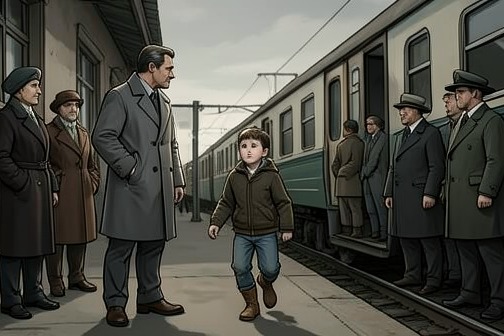
The killing of [Witold Trzeciak](entity:character-recall-character-witold-trzeciak-b1d9e946c0e6) turns a moment of recognition and apparent rescue into an execution. [Szmul Zachariasz](entity:character-recall-character-szmul-zachariasz-fce729d9da8c) recognizes the isolated, club-footed boy among a transport’s arrivals, promises him food and a reunion with Chaim, and then watches the welcome collapse into violence. Witold’s death is brief; the story around it is not. It reveals how deportation, disability, childhood attachment, and the camp’s language of order meet in one boy’s last hours.
## Arrival and recognition
A note from the camp’s Lagerführer reduces the incoming transport to arithmetic: twenty wagons from Hamburg, two more added at [Warsaw](entity:location-recall-location-a2daecdb29f1), and an estimated 1,980 deportees, of whom roughly 1,782 are expected to be fit for work. Against this calculation, Witold appears as a particular person: alone, walking painfully, and club-footed. His surgical boot has been left behind in the pile of luggage, braces, and prostheses on the platform. The missing boot is not incidental. Witold asks for it because he expects to need it in the fields, while the arrival system has already separated his body from something he depends on to walk.
[Szmul](entity:character-recall-character-szmul-c827c0d89630) calls him by name, and Witold’s initially empty expression gives way to gratitude and relief. He asks whether Chaim is there. In the course of explaining his recent history, he says that he was arrested at a station for vagrancy and sent to Pawiak Prison. He and the person with him feared they would be shot, but their captors changed their minds. Asked whether the woman he is looking for travelled on a transport, Witold says she went on foot, taken by her brother. His questions and partial news of his family emerge amid a larger deportation whose paperwork counts people as prospective labour and calls them settlers.
## A welcome interrupted
The reunion has a history that makes Szmul’s recognition more than an act of courtesy. From 1934 to 1937, Witold and Chaim were as close as twins, spending weekends at each other’s homes and sharing a bed whenever a frightening story, a black cat, Halloween, or [Walpurgis Night](entity:time-recall-time-d32f3ad3af3e) gave them an excuse. After Witold’s parents divorced in 1938, he travelled between his father in Łódź and his mother in Warsaw. He was twelve in 1939. The compressed childhood history gives emotional weight to the simple assurance that Chaim is present: the boy has reached someone who knew him before the arrests, journeys, and separation.
Szmul leads Witold away and appeals to Krebbs, the Kapo, for two minutes. The setting briefly offers the appearance of shelter: it is spring among birch trees, and Szmul speaks with the authority the German power has invested in him. Witold worries about his boot and his work in the fields. Szmul tells him that the luggage will be at the guest house, promises cheese sandwiches immediately and a hot meal later, and says that Chaim will come to find him. Witold welcomes the prospect of food. These practical assurances are sharply at odds with the missing boot and with the system that has delivered him there; for a few moments, however, they allow him to imagine an ordinary next step.
## Doll’s arrival and Witold’s death
That brief exchange is broken by [Paul Doll](entity:character-recall-character-paul-doll-263bff157203)’s staff car, its tyres slipping in the mud. Witold’s last words are his response to the promised food. Doll then asks what has been happening while the body is being dragged behind an ambulance. Szmul describes Witold as a troublemaker who kept asking for his surgical boot. Doll says he had noticed that something was wrong with the boy, then gives Szmul an appointment for Friday at six, in the garden, as night falls. The narration places that ominous instruction beside Witold’s death without explaining its full purpose.
The death itself receives no elaborate account. Witold falls as if in a swoon; Krebbs steps back. In less than a minute, Witold is dead. The brevity is part of the horror: the boy who had just been promised a meal and the presence of his childhood friend is reduced, almost at once, to a body being removed. The account does not specify the physical means of his death. It does, however, place Krebbs beside him, Doll at the scene, and Szmul within the chain of events, making the killing inseparable from the camp’s hierarchy of power.
## Violence beneath the language of order
Doll’s conduct at the scene belongs to a wider pattern of self-justification. Elsewhere he insists that kindness to Jews would mean cruelty to Germans, rejects ordinary distinctions between right and wrong in favour of outcomes, and presents himself as a normal man with normal feelings. His hostility is not softened by his claim to administrative or political reason. Even his objection to [Der Stürmer](entity:object-recall-object-der-st-rmer-1848db230a52) is framed as a tactical judgment: he argues that its lurid caricatures harm antisemitism by replacing what he considers scientific evidence. The objection criticizes propaganda’s effectiveness, not the persecution it serves.
The narration also sets such certainty against signs of a system that cannot make itself morally coherent. [Boris Eltz](entity:character-recall-character-boris-eltz-8a6f6c87ec3a) recalls learning that psychiatric patients were being killed to free beds for men who had broken down after killing civilians in [Poland](entity:location-recall-location-poland-919a7f7f62ac) and [Russia](entity:location-recall-location-russia-8ee8be401081). Later, Doll’s own questions about the camp’s stench, drunkenness, disease, rats, and brown snow pierce the language of purposeful work and loyalty. These broader contradictions do not explain Witold’s death away. They show the distance between the regime’s claims of order and the material consequences of its decisions.
Witold’s surgical boot gives that distance a concrete measure. The camp treats his arrival as a calculation of work capacity, while he understands the immediate problem of walking without the boot he needs for the fields. His disability is neither an abstract emblem nor a detail detached from the plot: it shapes his movement, his question, and the way others dismiss him. The promised luggage cannot restore what has been taken from him, and the promise of Chaim’s company cannot protect him. His killing extinguishes not only a life but the future reunion the scene had briefly made imaginable.
Event 34
Death of Szmul Zachariasz
The death of [Szmul Zachariasz](entity:character-recall-character-szmul-zachariasz-fce729d9da8c) is both a murder and the exposure of a coercive plot: [Paul Doll](entity:character-recall-character-paul-doll-263bff157203) has tried to use [Szmul](entity:character-recall-character-szmul-c827c0d89630) to kill or injure [Hannah Doll](entity:character-recall-character-hannah-doll-2c2e53cda395), but Szmul refuses to become the instrument of that violence. In Hannah’s later account, Szmul faces her, reveals Doll’s intention, and dies by Doll’s gun. The staged garden encounter turns a threatened attack into a testimony, leaving Hannah with a lasting understanding of Doll and prompting her to escape with the girls.
## Setting and Circumstances
Szmul’s place in the camp’s machinery makes him, in Doll’s eyes, useful and dangerous at once. As the [Sonderkommando](entity:organization-recall-organization-953030afb413) leader, he and the prisoners under his direction are forced to handle the dead: dragging bodies from the shower room, removing hair and valuables, loading the remains into the crematory, and dispersing the ashes. These duties expose the workers to the practical details of mass killing and make them witnesses to what the camp’s euphemisms conceal. Doll calls such a prisoner a bearer of secrets, but that label does not confer power or protection. It marks the peril of knowing too much while remaining under the commandant’s control.
The larger system around Szmul depends on organized deception as well as force. On the ramp, arrivals are reassured and directed through the undressing room; within the crematory process, bodies are reduced to tasks, counted and handled as consignments. The narrative’s attention to these routines makes the private scene in the garden part of the same world, not an isolated eruption of violence. Szmul has been made to serve a process that denies the humanity of its victims; Doll now tries to turn his forced service into a weapon against Hannah.
A separate chronology later gives the death a precise place in the sequence of events: Szmul stopped living at about 6:45 on April 30, 1943, an hour after the narrator’s arrest. That bare entry supplies a date and time that the remembered scene itself does not foreground. Its clipped form contrasts with Hannah’s detailed recollection of the garden, where gestures, faces, and the order of the shots remain vivid.
## Doll’s Coercive Plan
Before the killing, Doll makes the threat explicit in the dank space beneath [Crematory IV](entity:object-recall-object-crematory-iv-5813f02b51c4). With a gun in one hand and a cigar in the other, he instructs Szmul to practise dropping a weapon from his sleeve and thrusting it into a sack. He then names a deadline: [Shulamith Zachariasz](entity:character-recall-character-shulamith-zacharias-7586ae38017b) is to be brought for execution at noon on May 1 unless Doll cancels the order by telephone that morning. Szmul’s wife is therefore being used as leverage, and the threatened execution is presented as a condition Doll can control.
Doll connects that threat to Hannah’s survival, telling Szmul that the only way to keep his wife alive is to kill Doll’s. The bargain is designed to force Szmul into a double betrayal: violence against Hannah and, by implication, the abandonment of [Shulamith](entity:character-recall-character-shulamith-8792b2c168d5) to Doll’s power. Its apparent neatness is part of the cruelty. Doll reduces two women’s lives and Szmul’s choice to an arrangement he claims he can manage with a telephone call.
The later account reveals that Szmul does not carry out the attack Doll has rehearsed with him. Instead, Doll invites Hannah into the garden to watch Roman candles, presenting the occasion through the pretext of a birthday present from Szmul. The three stand in the deepening twilight; beyond them, the [Walpurgisnacht](entity:expression-recall-expression-walpurgisnacht-0a274d724ee5) blaze and possibly a rising rocket frame the encounter. Szmul waits on the other side of the garden fence, still wearing his prisoner’s stripes. The setting offers a moment of apparent festivity, but its staged intimacy conceals the threat Doll has engineered.
## The Killing
As Hannah remembers it, Szmul draws a long, narrow tool or weapon from his sleeve. The scene is uncertain and partly made to look like play; its very uncertainty reflects the contrivance of Doll’s plan. Doll kicks open the gate and urges them onward. Rather than attack Hannah, Szmul stands his ground, parts his shirt, and places the point against his own chest. He looks Hannah in the eye and tells her that Doll wanted him to do this to her.
That disclosure changes the meaning of the encounter. Szmul does not merely fail to obey Doll’s plan; he makes the plan visible to the person it was meant to harm. Hannah recalls that Szmul had rarely looked her in the eye before. His direct gaze interrupts the concealment on which Doll has relied, while his words identify the commandant—not the prisoner—as the source of the danger. Szmul’s action does not free him from Doll’s control, but it refuses the role Doll has assigned him.
Doll answers by asking what use Szmul is, then shooting him in the face. He crouches and fires again into the back of Szmul’s neck. Hannah remembers Doll turning slowly on his haunches after Szmul stops quivering and looking up at her. The sequence is brutally specific: Szmul’s refusal and disclosure are followed not by escape or reprieve, but by Doll’s immediate execution of him. The killing is not a consequence of an attack on Hannah; it is Doll’s response to Szmul’s refusal and to the truth he has spoken.
## Hannah’s Recognition and Flight
Hannah remembers Doll as covered in blood and still trying to smile. The image makes recognition inseparable from revulsion: she suddenly understands him as a nightmarish little boy caught doing something plainly disgusting, yet persisting in the effort to smile. This is not simply a new fact about what Doll has done. It is a changed understanding of the person she has been watching, produced by seeing his violence at close range and hearing Szmul name his intention.
She takes the girls to Romhilde Seedig’s home and leaves as soon as she can. Her account stresses the urgency of getting away, rather than describing any further confrontation with Doll. The flight is the immediate human consequence of the scene: Szmul is dead, the threat to Hannah has become unmistakable, and the garden no longer offers even the appearance of safety.
Years later, Hannah remains troubled not only by the fact of Szmul’s death but by the manner in which Doll caused it. She identifies Doll’s prevention of Szmul’s own suicide as the worst part: rather than allowing him to die by his own hand, Doll destroys his face. She also wonders whether Doll had persuaded or pressured Szmul to hurt or kill her, and how that pressure worked. The account gives no answer to that final question. Its uncertainty preserves the distinction between what Hannah witnessed—the attempted coercion, Szmul’s refusal, and Doll’s shots—and what she can only infer about the pressure behind them.
## Significance
The scene concentrates the camp’s larger logic into a private act. In the surrounding narrative, the machinery of killing is described as a means of accelerating murder, economizing effort, and sparing the nerves of the killers; bullets and pyres, too, would have served the same lethal purpose. Against that system, the garden’s candles and birthday pretext do not soften the violence. They show how ordinary forms of invitation and celebration can be made to conceal an execution and an attempted murder.
Szmul’s final act also complicates his enforced role within the killing apparatus. He has been compelled to perform the camp’s work, and Doll treats that coerced position as evidence that he can be made to do anything. Yet in the decisive encounter Szmul turns toward Hannah rather than against her, discloses the threat, and refuses Doll’s intended use of him. The narrative does not make this refusal undo the violence or deliver him from it. Instead, his brief act of truth-telling leaves Hannah with the knowledge that changes her course, while Doll’s attempt to control the story ends in a killing that exposes his own responsibility.
Event 35
Battle of Kursk
The [Battle of Kursk](entity:event-recall-event-dc7b52efd068) is the eastern-front defeat that turns [Martin Bormann](entity:character-recall-character-martin-bormann-d74a56f4ae41)’s warning to [Angelus Thomsen](entity:character-recall-character-angelus-thomsen-4d6c7ca47636) into a brutal personal consequence: [Boris Eltz](entity:character-recall-character-boris-eltz-8a6f6c87ec3a) dies there in a burning Panther, and receives a posthumous decoration. The account gives the battle both immense scale and an intimate cost, placing military ambition alongside the novel’s wider portrait of a regime mobilizing people and institutions for war and mass murder.
## Forecast and Strategic Stakes
During a conversation with Angelus Thomsen, Martin Bormann describes the Wolf’s Lair as almost a pocket concentration camp, then points him toward the Kursk salient. [Adolf Hitler](entity:character-recall-character-adolf-hitler-e6e3f1777476), Bormann says, is preparing a surprise for the German regime’s enemies in the east: Operation Citadel, to begin when the ground hardens. The warning makes the salient a focus of expectation before the battle itself appears in the narrative. Its outcome will expose the distance between confident planning and the defeat that follows.
That confidence sits within a broader machinery of wartime priorities. In another account, a camp official describes pressure from the [Economic Administration Head Office](entity:organization-recall-organization-86ca0fe228fe) to increase labor for the munitions industries, opposed by the Reich Central Security Department’s pressure to dispose of evacuees. He objects in particular to a proposal to work able-bodied mothers in a boot factory, invoking the practical impossibility of separating them from their children at the arrival ramp. The clash shows how military production and persecution compete within the same administrative system, without making the battle itself the cause of the extermination policy.
## The Battle and Boris Eltz’s Death
The narrative describes Kursk as the climactic day of German defeat and conveys its scale through an engagement of 13,000 tanks across a battlefield compared to the size of Wales. For Boris Eltz, this immense confrontation contracts to the interior of his Panther: the tank is already a ball of fire when he rams it sideways into two advancing Soviet T-34s. The account records the act and its fatal outcome without turning it into a victory; Boris is killed, and the military honor awarded afterward cannot undo the loss.
Boris’s death belongs to a sequence of wartime deaths that makes the campaign’s consequences visible among the novel’s characters. [Roland Bullard](entity:character-recall-character-roland-bullard-f4f7540b134c) is shot in the back of the neck on May Day, and [Fritz Mobius](entity:character-recall-character-fritz-mobius-e3c937040e4e) dies of a heart attack during a nightlong interrogation on June 1. Boris is killed on July 12, the account’s date for the climactic German defeat at Kursk. The later narrative records that [Wolfram Prufer](entity:character-recall-character-wolfram-prufer-78c6cf90445d) is beaten to death during the [Sonderkommando](entity:organization-recall-organization-953030afb413) revolt of October 7, 1944. These distinct deaths are not presented as one battle’s casualties, but their sequence places Boris’s fate within a world in which military collapse and the regime’s violence keep producing new losses.
## Defeat and the Novel’s Wider War
Kursk also sits against a discussion of how the Nazi extermination policy developed. [Konrad Peters](entity:character-recall-character-konrad-peters-3375e9a11977) traces a July 31, 1941 authorization, drafted by Adolf Eichmann and [Reinhard Heydrich](entity:character-recall-character-reinhard-heydrich-3a78d0693532) and signed by Hermann Göring, and describes an initial expectation that Jews might be expelled to remote, barren territory after a quick victory over [Russia](entity:location-recall-location-russia-8ee8be401081). As territorial expulsion receded and officials faced the additional millions brought under German control, pressure from below intensified; Peters identifies the killing of women and children as a decisive escalation. His account stresses that gas chambers and crematoria were means of speeding the killing and sparing the killers’ nerves, not prerequisites for the regime’s murderous will: bullets and pyres could have served that purpose too.
The juxtaposition does not equate a military battle with the Holocaust. Instead, Kursk’s defeat belongs to a war whose leaders pursued military operations while their institutions organized forced labor, deportation, and extermination. Bormann’s earlier prediction makes the salient a promise of German action; Boris’s death makes the later defeat irreducibly human. The posthumous Pour le Mérite marks recognition after the decisive fact: he did not survive the battle.
Event 36
Auschwitz Sonderkommando uprising
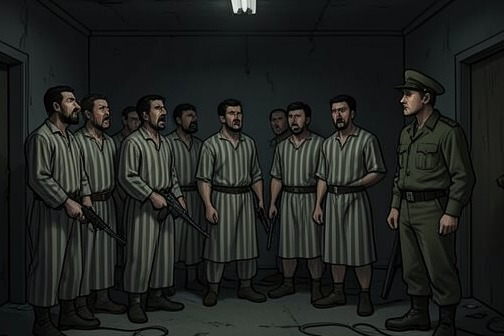
The [Auschwitz Sonderkommando uprising](entity:event-recall-event-5ffb403f1991) enters the novel in a compressed but consequential account of deaths: on October 7, 1944, [Wolfram Prufer](entity:character-recall-character-wolfram-prufer-78c6cf90445d) and two other [SS](entity:organization-recall-organization-d352e2475f65) were beaten to death with rocks and pickaxes during the revolt. The passage supplies no extended battle narrative; instead, the stark sentence registers the revolt as an eruption of violence inside a system organized around prisoner exploitation and mass murder.
## Policy and the camp system
The novel’s broader historical account traces the escalation of Nazi policy to the summer of 1941. It identifies July 31 as a moment of high-level authorization, then describes how an earlier imagined plan to remove Jews to remote, inhospitable regions gave way under pressure from officials in occupied [Poland](entity:location-recall-location-poland-919a7f7f62ac). In this account, the decisive expansion was from killing men to killing women and children. The narrative presents policy not as a single isolated instruction but as authorization interacting with local pressure and increasingly radical implementation.
That account also distinguishes the machinery of killing from the intention behind it. [Konrad Peters](entity:character-recall-character-konrad-peters-3375e9a11977) tells [Angelus Thomsen](entity:character-recall-character-angelus-thomsen-4d6c7ca47636) that gas chambers and crematoria accelerated murder, economized on resources, and spared the killers’ nerves, but were not indispensable to the perpetrators’ purpose. He points to mass shootings by the [Einsatzgruppen](entity:organization-recall-organization-einsatzgruppen-d4b9bd17f4e9) and argues that bullets and pyres could have achieved the same end. The distinction frames the uprising within a system whose violence depended on organized intent, not on any one technology.
## Forced labor and calculated survival
Elsewhere, the novel shows the camp’s competing demands through a discussion of prisoners sent to [Buna-Werke](entity:location-recall-location-buna-werke-17a8d481e9c2). [Suitbert Seedig](entity:character-recall-character-suitbert-seedig-25b2a8b9e290) describes a schedule beginning with reveille at three, followed by a ninety-minute march; prisoners work until six, return at eight, and carry their casualties. He asks how such exhausted people can be made productive. The details expose the physical cost concealed by administrative language about labor strength.
The argument turns explicitly to survival as a means of extending exploitation. Seedig reports that prisoners are still dying at a rate of one thousand per week. [Frithuric Burckl](entity:character-recall-character-frithuric-burckl-bc5fa23937d1) proposes a twenty-per-cent increase in rations, not as a rejection of forced labor but because prisoners would have more strength and last longer. A separate calculation places an adult’s needs at 2,500 calories at rest, contrasts that with 300 calories in some Polish ghettos, and estimates that a heavy worker on 1,100 calories loses about three kilograms a week. These figures make the contradiction plain: the camp seeks usable labor from people whose deprivation is also part of the system.
The novel sets that labor calculus beside the pressure to dispose of prisoners. Angelus Thomsen describes himself as caught between the [Economic Administration Head Office](entity:organization-recall-organization-86ca0fe228fe), which wants labor strength increased for the munitions industries, and the Reich Central Security Department, which presses for the removal of evacuees. This conflict supplies a wider institutional context for the revolt, but the account does not identify it as the revolt’s direct cause.
## The revolt and its recorded outcome
The novel’s specific record of the uprising is brief: on October 7, 1944, Wolfram Prufer and two other SS were beaten to death with rocks and pickaxes. It names the victims, the weapons, and the date, but does not develop the event into a sequence of plans or actions. That compression gives the episode the form of an entry in a grim ledger, set among other deaths and losses rather than staged as a triumphant reversal of power.
The immediate consequence recorded is the deaths of the three SS. The passage does not claim that the uprising ended the camp system or altered the larger course of extermination. Its significance lies in the fact that prisoners acted against the personnel enforcing that system, even as the surrounding narrative depicts their lives as subject to administrative calculation, starvation, forced labor, and killing.
## Aftermath and the novel’s moral accounting
The book’s retrospective account connects the Buna labor system to later legal judgments without presenting those judgments as a trial of the uprising. In July 1948, thirteen [IG Farben](entity:organization-recall-organization-ig-farben-130dd58aa9f0) executives and managers were convicted at Nuremberg; Suitbert Seedig received an eight-year sentence for slavery and mass murder, while [Rupprecht Strunck](entity:character-recall-character-rupprecht-strunck-81e35def27f7) received seven years for plunder and spoliation, slavery, and mass murder. The account adds that Buna-Werke never produced a kilogram of synthetic rubber or a millilitre of synthetic fuel. The contrast between enormous human cost and absent industrial output sharpens the novel’s indictment of a system that consumed prisoners in the name of production.
Against this background, the revolt’s terse appearance carries particular weight. The novel does not make it a clean victory or claim more than its recorded outcome. It places the prisoners’ act within a world where labor, starvation, deportation, and murder were administered together, and where the postwar record assigns legal responsibility to some of the institutions and officials that sustained that world.
Event 37
July 20, 1944 attempt to assassinate Hitler
The [July 20, 1944 attempt to assassinate Hitler](entity:event-recall-event-1944-7-20-ef762ca71217) is presented less as a narrated action than as a dividing line in the novel’s account of persecution, resistance, and individual fate. Its most concrete consequence is the arrest of [Konrad Peters](entity:character-recall-character-konrad-peters-3375e9a11977), whose death in [Dachau](entity:location-recall-location-dachau-577a13cf948f) connects the failed attempt to the regime’s continuing violence against its opponents.
## Background and Stakes
The novel sets the event against an earlier escalation of Nazi policy. In a retrospective discussion of July 1941, a letter sent for authorization described a total solution and the assembly of manpower in the east. The account traces a shift from imagined expulsion to killing on a larger scale, including women and children, as territorial schemes receded and officials faced the consequences of annexing more Jewish communities.
The narrative also stresses that industrial killing was not the source of the regime’s murderous purpose. In a conversation with [Angelus Thomsen](entity:character-recall-character-angelus-thomsen-4d6c7ca47636), Konrad Peters argues that gas chambers and crematoria accelerated killing and reduced the strain on the killers, but that bullets and pyres could have achieved the same end. He points to the [Einsatzgruppen](entity:organization-recall-organization-einsatzgruppen-d4b9bd17f4e9)’s killings by bullet as evidence of the will already present. This discussion supplies the political and moral landscape surrounding the later assassination attempt; the novel does not establish that the plotters acted for any particular reason connected to these policies.
## The Attempt and Its Immediate Consequences
The novel does not dramatize the assassination attempt or describe how it was carried out. Instead, it records a consequence of the ensuing repression: Peters was one of approximately five thousand suspects arrested in connection with the July 20, 1944 attempt. The scale of that figure places his arrest within a broad roundup rather than presenting it as an isolated encounter, while the account gives no further details about the other suspects or the proceedings against them.
## Peters’s Death
Peters’s fate extends the event’s consequences into the final months of the war. He was among approximately twelve thousand prisoners who died of typhus in Dachau during the first four months of 1945. The novel distinguishes this cause and setting from his arrest: it reports that he was detained in connection with the attempt, then identifies disease in the camp as the circumstance of his death. The compressed account makes the plot’s aftermath part of a larger history in which political suspicion and the conditions of imprisonment carried lethal consequences.
## Resistance and Retrospective Meaning
In the novel’s later reflection on life under [National Socialism](entity:concept-recall-concept-national-socialism-2a8314dfe38e), the men and women of July 20 appear among martyrs alongside members of the Red Orchestra and the White Rose. They are included in a wider reckoning that encompasses victims, perpetrators, collaborators, witnesses, conspirators, and minor obstructors: people whose actions or circumstances disclosed who they were. This retrospective framing does not supply the missing particulars of the attempt; instead, it gives the event significance as an act of resistance remembered within a society forced to confront what its members had done, endured, or opposed.
Event 38
Deportation of Hungarian Jews and “Aktion Doll”
The [Deportation of Hungarian Jews and “Aktion Doll”](entity:event-recall-event-183a3e7e6f98) is the novel’s account of a late-war mass deportation that proceeded despite [Germany](entity:location-recall-location-germany-2e3723c2f347)’s evident defeat. In April 1944, the Reich diverted troops to [Budapest](entity:location-recall-location-efd6a1abf62c); close to half a million Jews from [Hungary](entity:location-recall-location-79524dcb2a7f) were deported and murdered in [Kat Zet II](entity:location-recall-location-kat-zet-ii-6fa59e519bdb). The narration sets this action against the worsening state of the war and traces the policy’s development back to earlier decisions to kill women and children as well as men.
## Background and Policy Formation
The account reaches back to July 31, 1941, when a letter drafted by Eichmann and [Reinhard Heydrich](entity:character-recall-character-reinhard-heydrich-3a78d0693532) was sent to Goring and returned with his signature. The letter conveyed [Adolf Hitler](entity:character-recall-character-adolf-hitler-e6e3f1777476)’s wish for a total solution and the authority to begin. At this stage, the regime may still have envisaged expelling Jews to a cold, barren region beyond the Urals or in the Arctic Circle after a rapid victory over [Russia](entity:location-recall-location-russia-8ee8be401081).
That territorial answer receded as German authorities in [Poland](entity:location-recall-location-poland-919a7f7f62ac) confronted the additional three million Jews brought under their control through annexation and argued that they could not manage the numbers. The narration describes pressure from below and a further turn in policy by August or September: killing expanded from men, who had already been murdered for months, to women and children. The account thus presents extermination as a process shaped by both central authorization and escalating pressures among officials, rather than as a single isolated decision.
## Deportation to Kat Zet II
By April 1944, the war was described as long lost, cities had been razed, and millions of people were half-starved, homeless, and dressed in singed rags. Even in those conditions, the Reich diverted troops to Budapest and began deportations. The contrast is stark: resources and military attention were still committed to the persecution and murder of Jews while the wider state faced catastrophic wartime conditions.
The scale of the outcome is stated in the exchange between [Angelus Thomsen](entity:character-recall-character-angelus-thomsen-4d6c7ca47636) and his aunt. Close to half a million Jews from Hungary were deported and murdered in Kat Zet II; two hundred thousand survived. Her satisfaction that Adolf Hitler had got the Hungarians is immediately qualified by Thomsen’s correction that the outcome was not total. The figures preserve both the reach of the killing and the survival that the boastful language of accomplishment would obscure.
## The Name and Its Irony
[Aktion Doll](entity:action-recall-action-5ed3907400d7) is presented as a name for this mass deportation and murder, not as evidence that [Paul Doll](entity:character-recall-character-paul-doll-263bff157203) personally directed the operation. The episode’s political irony lies in its continuation after defeat was plain: the regime persisted in killing even as its cities lay in ruins and its population suffered hunger and displacement. Thomsen compares this momentum to a sequence of blows in which each act is made to justify the next, until the perpetrators have exhausted their strength.
The conversation also gives the episode a chilling measure of the regime’s self-understanding. Thomsen’s aunt recalls that Adolf Hitler regarded the deportation of the Hungarians as his greatest achievement on the world stage, even his greatest contribution as a statesman. Her approving tone turns mass murder into a point of pride; set beside the scale of deportation and death, that claim exposes the moral inversion at the heart of the regime’s political language.
## Significance in the Novel
The event joins the machinery of extermination to the novel’s wider depiction of competing administrative demands. Elsewhere, Thomsen describes pressure from the [Economic Administration Head Office](entity:organization-recall-organization-86ca0fe228fe) to increase labor strength for munitions production, set against pressure from the Reich Central Security Department to dispose of as many deportees as possible. The contradiction clarifies the setting in which deported people could be treated at once as potential labor and as targets for removal, without making the two aims mutually exclusive.
The account also refuses to make the industrial apparatus the source of the killers’ intent. In a separate reflection, [Professor Entress](entity:character-recall-character-professor-entress-fdce3fbcfcd0) tells Thomsen that gas chambers and crematories accelerated killing, economized effort, and spared the killers’ nerves, but that bullets and pyres would have achieved the same end: the will to kill was already present. Read alongside Aktion Doll, that distinction makes technology and administrative coordination part of the means, while locating the decisive fact in the regime’s continuing commitment to murder.
Event 39
Suicide of Adolf Hitler and Eva Braun
The suicide of [Adolf Hitler](entity:character-recall-character-adolf-hitler-e6e3f1777476) and Eva Braun is recounted as the hinge between the Nazi leadership’s final acts and the attempted flight from the collapsing regime. The account gives no scene of the couple’s deaths; instead, it places their joint suicide and the subsequent burning of their bodies immediately before [Martin Bormann](entity:character-recall-character-martin-bormann-d74a56f4ae41)’s desperate attempt to escape, exposing how closely ritualized loyalty and personal flight coexist at the regime’s end.
## The Event and Its Immediate Aftermath
The narrative identifies Hitler and Eva Braun as newlyweds who died by joint suicide. Their bodies were then burned, an act Bormann oversaw together with [Joseph Goebbels](entity:character-recall-character-joseph-goebbels-e38487c8d7d7). The passage concentrates on this sequence rather than the circumstances of the deaths themselves: suicide, immolation, and the departure of those who remained. It does not specify the couple’s precise location or the means of suicide, so the event is presented through its aftermath and its place in Bormann’s escape.
That compressed account gives the burning particular weight. The final treatment of the bodies is not described as an isolated detail but as an operation overseen by senior figures even as the Nazi center disintegrated. Bormann’s involvement places him among the people managing the regime’s last rites; his flight follows almost at once.
## Bormann’s Flight and Fate
In the small hours of May 1, 1945, Bormann tried to flee the [Reich Chancellery](entity:location-recall-location-e35ddb8748e4) in [Berlin](entity:location-recall-location-berlin-54cb4a75d0f6). A Russian artillery shell wounded him, after which he took cyanide. The narrative notes that the facts of his fate took several years to verify, making his disappearance part of the event’s unsettled aftermath rather than an immediately confirmed death.
Bormann was later condemned to death in absentia on October 1, 1946. That postwar judgment followed the uncertainty over what had happened during his escape: the account distinguishes the later confirmation of his fate from the legal verdict delivered in his absence. His final flight did not erase his role in the last acts of the leadership he had served.
## Political Context and Narrative Significance
The novel places this ending against an earlier account of the policy of mass murder. A conversation set in 1945 traces what it calls the crime without a name to a letter dated July 31, 1941, presented as carrying Hitler’s wish for a total solution. The account then describes how the idea of expelling Jews to a remote territory receded as pressure mounted among Nazi authorities in occupied [Poland](entity:location-recall-location-poland-919a7f7f62ac), and how the killing widened to include women and children. This political history gives the suicide its broader context: the deaths of the leaders close the story of a regime whose decisions had already set mass violence in motion.
The same discussion resists treating the killing as merely a product of technology. Gas chambers and crematories are described as means to accelerate murder, economize, and spare killers’ nerves; the narrative adds that mass killing would have continued with bullets and pyres. Against that judgment, the final immolation of Hitler and Eva Braun does not offer a moral resolution. It marks the regime’s collapse, while Bormann’s participation and subsequent flight preserve the distinction between its end and the accountability of those who served it.
Event 40
Trial and execution of Paul Doll
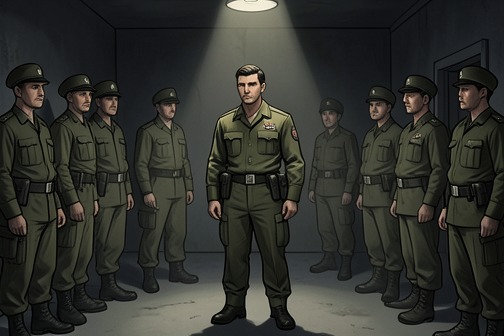
The [Trial and execution of Paul Doll](entity:event-recall-event-0aefbeadd116) close the novel’s account of a commandant whose administrative career moved between the routine management of forced labor and the machinery of mass murder. After a temporary demotion, Doll returned to command; the postwar account then records his capture, trial, transfer to Polish custody, and execution. His final statement acknowledged grave responsibility, but came after the institutional violence he had administered had already taken its toll.
## Command and Responsibility
Doll’s authority is shown against the material conditions imposed on prisoners. [Suitbert Seedig](entity:character-recall-character-suitbert-seedig-25b2a8b9e290) describes a day beginning with reveille at three, followed by a ninety-minute march to the [Buna-Werke](entity:location-recall-location-buna-werke-17a8d481e9c2); workers finish at six, return at eight, and carry their casualties. He reports that prisoners are still dying at a rate of one thousand a week. In the same discussion, [Frithuric Burckl](entity:character-recall-character-frithuric-burckl-bc5fa23937d1) argues for a modest twenty-per-cent increase in rations so that the laborers will have more strength and last longer. The exchange exposes the economic logic surrounding the camp: prisoners are treated as a workforce to be maintained for production even as their bodies are depleted by the system.
Doll’s own language elsewhere makes the divide between administrative function and moral knowledge harder to sustain. Addressing a prisoner, he recognizes the man’s capacity to kill and says that such people have their uses. The remark does not describe the later trial, but it belongs to the portrait of a commander who can perceive violence plainly while continuing to work within its machinery.
## Demotion and Return to Command
In June 1943, Doll was demoted sideways to a clerical post at the Inspectorate of Concentration Camps in [Berlin](entity:location-recall-location-berlin-54cb4a75d0f6). The narrative places this reassignment in a city under increasingly frequent bombing, but does not present it as a reckoning with his conduct. In May 1944 he was reinstalled as commandant. The movement from command to paperwork and back again makes his removal temporary rather than a break with the system he served.
## Capture, Trial, and Execution
Doll was captured in March 1946, tried at Nuremberg, and delivered to the Polish authorities. The account does not dwell on courtroom proceedings; it moves directly from the sequence of custody and trial to his fate. On April 16, 1947, he was hanged outside [Bunker 11](entity:object-recall-object-bunker-11-0ce8dd45efb3) at [Kat Zet I](entity:location-recall-location-kat-zet-i-9d1fd36655ba). The place of execution returns his death to the camp landscape in which his authority had operated.
In his final statement, Doll wrote, ‘In the solitude of my cell I have come to the bitter realisation that I have sinned gravely against humanity.’ The admission is neither a detailed account of his acts nor an undoing of their consequences. Its force lies in the contrast between the language of personal recognition and the long period in which his office had been part of an organized system of coercion and killing.
## Postwar Accountability
Doll’s fate appears alongside the outcomes for other figures connected with the camp and its industrial exploitation. In July 1948, thirteen [IG Farben](entity:organization-recall-organization-ig-farben-130dd58aa9f0) executives and managers were convicted at Nuremberg; Suitbert Seedig received an eight-year sentence for slavery and mass murder, while [Rupprecht Strunck](entity:character-recall-character-rupprecht-strunck-81e35def27f7) received seven years for plunder and spoliation, slavery, and mass murder. Frithuric Burckl was not among those executives. The account also notes that the Buna-Werke produced not a kilogram of synthetic rubber or a millilitre of synthetic fuel. These separate outcomes do not equate the defendants’ roles or sentences, but they place Doll’s execution within a broader postwar reckoning with camp command, forced labor, and the companies that sought to exploit it.
Event 41
IG Farben Trial
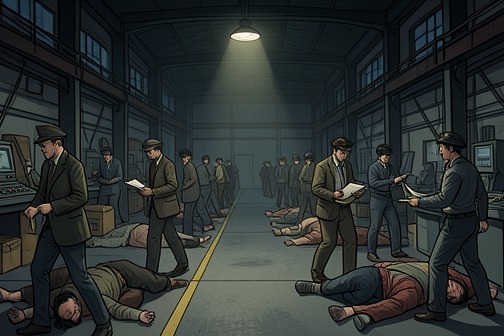
The [IG Farben Trial](entity:event-recall-event-ig-farben-96764fe21e60) marks a postwar reckoning with the company’s executives and managers, but its significance in the narrative reaches beyond the courtroom: the convictions are set against the exploitation and mass death embedded in the industrial world they served, and against the striking failure of the [Buna-Werke](entity:location-recall-location-buna-werke-17a8d481e9c2) to produce a kilogram of synthetic rubber or a millilitre of synthetic fuel.
## The industrial setting
The novel places industrial enterprise within the camp’s machinery of forced labor. At the Buna site, prisoners move in frantic lines under the screams of Kapos, [SS](entity:organization-recall-organization-d352e2475f65) noncommissioned officers, and company foremen. Among them, plant designers, engineers, and administrators from [IG Farben](entity:organization-recall-organization-ig-farben-130dd58aa9f0) facilities in Frankfurt, Leverkusen, and Ludwigshafen pick their way past wounded, unconscious, and dead bodies, carrying leather-bound notebooks and retractable measuring tapes. The contrast makes corporate presence concrete: technical inspection and business routine continue amid the physical consequences of the system that supplies labor.
The violence also leaves material traces beyond the worksite. The camp commander describes water rendered undrinkable, with fermenting matter and a breached water table making the stench worse. On a drive back, he repeatedly stops to smell the air and finds it worsening. These episodes do not establish what was presented in court; they show the wider world against which the later corporate convictions acquire meaning, where industrial and camp operations coexist with contamination, bodily degradation, and death.
## The convictions and sentences
In July 1948, thirteen IG Farben executives and managers were convicted at Nuremberg; [Frithuric Burckl](entity:character-recall-character-frithuric-burckl-bc5fa23937d1) was not among them. [Suitbert Seedig](entity:character-recall-character-suitbert-seedig-25b2a8b9e290) received an eight-year prison sentence for slavery and mass murder. [Rupprecht Strunck](entity:character-recall-character-rupprecht-strunck-81e35def27f7), recalled from early retirement, received seven years for plunder and spoliation, slavery, and mass murder. The narrative identifies these individuals and the crimes attached to their sentences without supplying a fuller account of the proceedings or claiming that every conviction rested on the same findings.
The sentencing gives the industrial story a legal aftermath, but not a neat resolution. The named penalties register personal consequences for company figures, while the surrounding account has already shown people in business suits moving through a workplace marked by injured and dead prisoners. The contrast places official accountability beside the ordinary administrative and technical routines through which the industrial project was pursued.
## A failed project and its human cost
The trial’s sharpest material counterpoint is the Buna-Werke’s failure: not a kilogram of synthetic rubber and not a millilitre of synthetic fuel was ever produced there. This fact turns the project’s outcome into more than a measure of industrial inefficiency. In the same narrative that records forced labor and mass murder, the plant’s unfulfilled production goal makes the scale of human cost impossible to mistake for successful manufacture.
The novel also presents the camp’s pollution and stench as part of the violence’s lived environment. The water is undrinkable, its contents have begun to ferment, and the smell grows more oppressive. Elsewhere, the camp commander asks why the snow is turned brown and why the meadow was made to churn and spit. Such images do not serve as trial testimony in the account; they broaden the moral frame around the verdicts by showing the physical world that the camp system leaves behind.
## Narrative significance
The IG Farben Trial appears near the end of a chain of consequences that extends from camp administration and industrial collaboration into postwar punishment. Its concise listing of convictions and sentences gives names and durations to legal accountability; the final production figure, by contrast, reduces the promised industrial achievement to absolute failure. Together, these details resist a view of the Buna enterprise as merely an unfinished factory project. The labor and deaths surrounding it, and the convictions that follow, remain part of the same account.
Event 42
German currency reform

The [German currency reform](entity:event-recall-event-6499a72402a5) of June 20, 1948 marks a sharp economic reversal in the narrator’s postwar account: a change of banknotes helped end an economy organized around scarcity and exchange, and introduced a free market without rationing or price controls. Its significance is presented through the contrast between two periods of monetary collapse—and through the narrator’s concise judgment that the new system worked.
## Background: Two Different Worthless Currencies
The narrator compares the reform with the hyperinflation of his adolescence, when money retained its value for only a few hours. On payday, people rushed to complete their weekly or monthly shopping immediately, before their wages lost purchasing power. The postwar crisis differed in a telling way: money was already worthless at the outset. The account therefore distinguishes rapid depreciation from the prior collapse of value, rather than treating both periods as the same kind of inflation.
## The Reform and Its Effects
The narrator describes the answer as a change of banknote. The June 20 reform ended the cigarette-based economy, in which a Lucky Strike had become too valuable to smoke, and brought in the Soziale Marktwirtschaft: a free market without rationing or price controls. The change is presented not as a partial adjustment but as a transition out of an economy where cigarettes functioned as valuable exchange goods and ordinary money could not reliably serve its purpose.
## Place in the Postwar Narrative
The reform appears in the narrator’s account of September 1948, as he sets out on a journey through a [Germany](entity:location-recall-location-germany-2e3723c2f347) trying to recover from war. Its brisk conclusion—that the new system worked—stands beside his more troubled account of personal recovery: outward life could resume, while an inner life remained difficult to construct. The economic change thus supplies a concrete measure of postwar transformation without implying that material recovery resolved the narrator’s private estrangement.